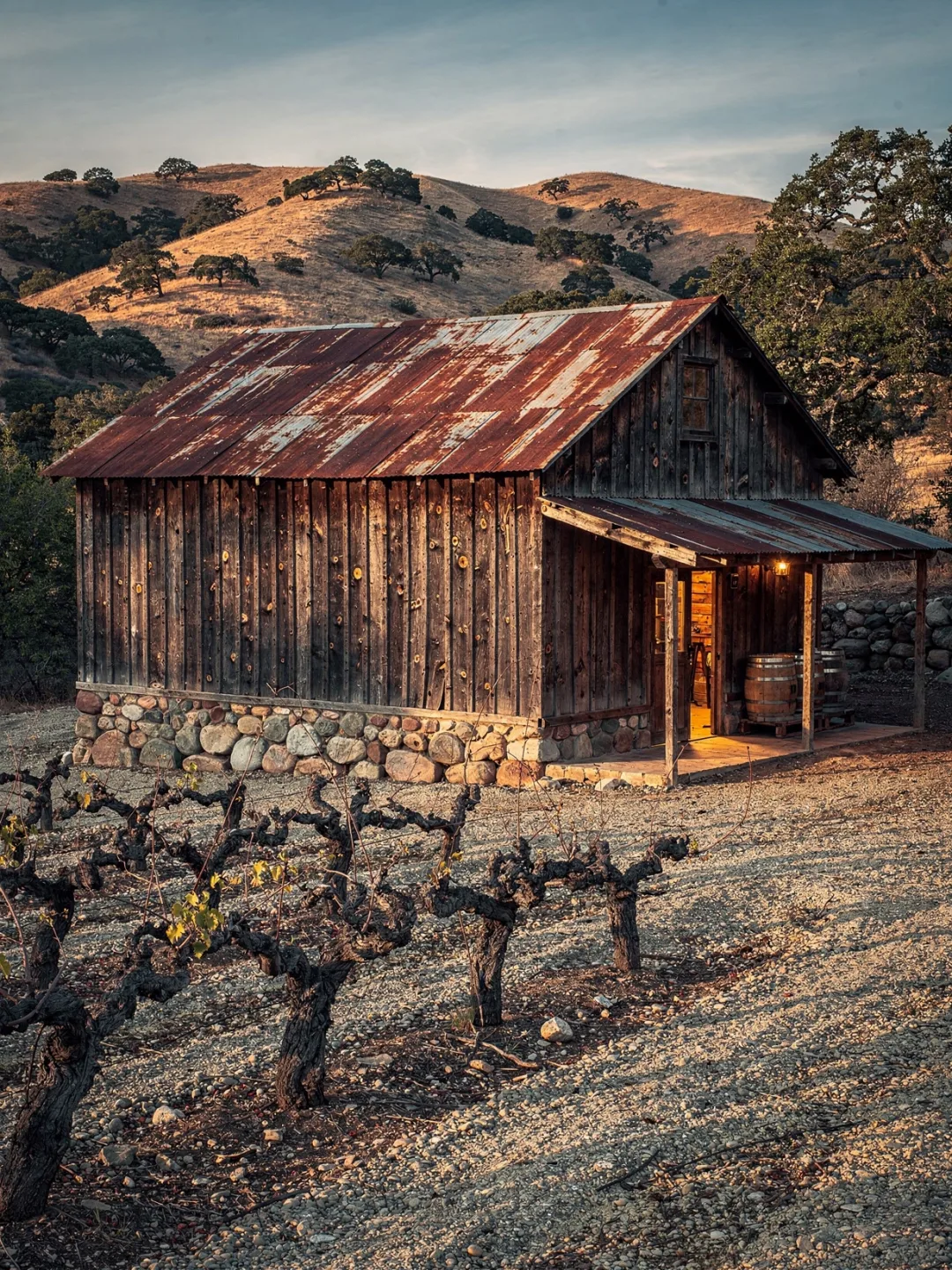
Mission to Rhône
Region & History
On September 1, 1772, Franciscan Father Junípero Serra founded Mission San Luis Obispo de Tolosa, the fifth in a chain of twenty-one California mission stations. Vines grew there from the very beginning. The monks needed sacramental wine, but they also brewed for the everyday table. The vines spread faster than the church itself.
Father Luis Antonio Martínez led the mission for thirty-four years and pushed winegrowing forward with great energy. Under him, a handful of vines grew into a full vineyard. He supplied entire neighboring missions whenever their own harvest failed. Some of it even traveled by ship to England and Russia — wine from a stretch of coastline that hardly anyone in Europe had ever heard of.
More than a hundred years later, an immigrant arrived from Indiana. In 1882, rancher Andrew York built his Ascension Winery on York Mountain, a cool slope near the coast, and planted Zinfandel. His three sons helped build the cellar, carrying stone after stone from their own land. The winery carries a different name today. It remains the longest continuously operating winery in the entire county.
For nearly a century, Paso Robles stayed a sideshow. That changed in 1975, when Gary Eberle planted California's first documented Syrah vines at Estrella River Winery — a Rhône variety almost unknown in the country at the time. Three years later, he bottled the state's first varietal Syrah. Other winemakers copied his cuttings. A lone pursuit turned into a movement that would later call itself the Rhone Rangers.
The entire coastal region got its name late, and all at once. On October 24, 1985, the US federal agency ATF (today's TTB, responsible for wine and spirits law) declared Central Coast its own AVA — American Viticultural Area, the American counterpart to an appellation. The application came from Taylor California Cellars in Gonzales. The area was enormous, stretching from San Francisco Bay to Santa Barbara. Too broad for its own ambitions: Paso Robles alone split, in 2014, following a petition filed in 2007, into eleven distinct sub-AVAs.