From Farm to Distillery
Region & History
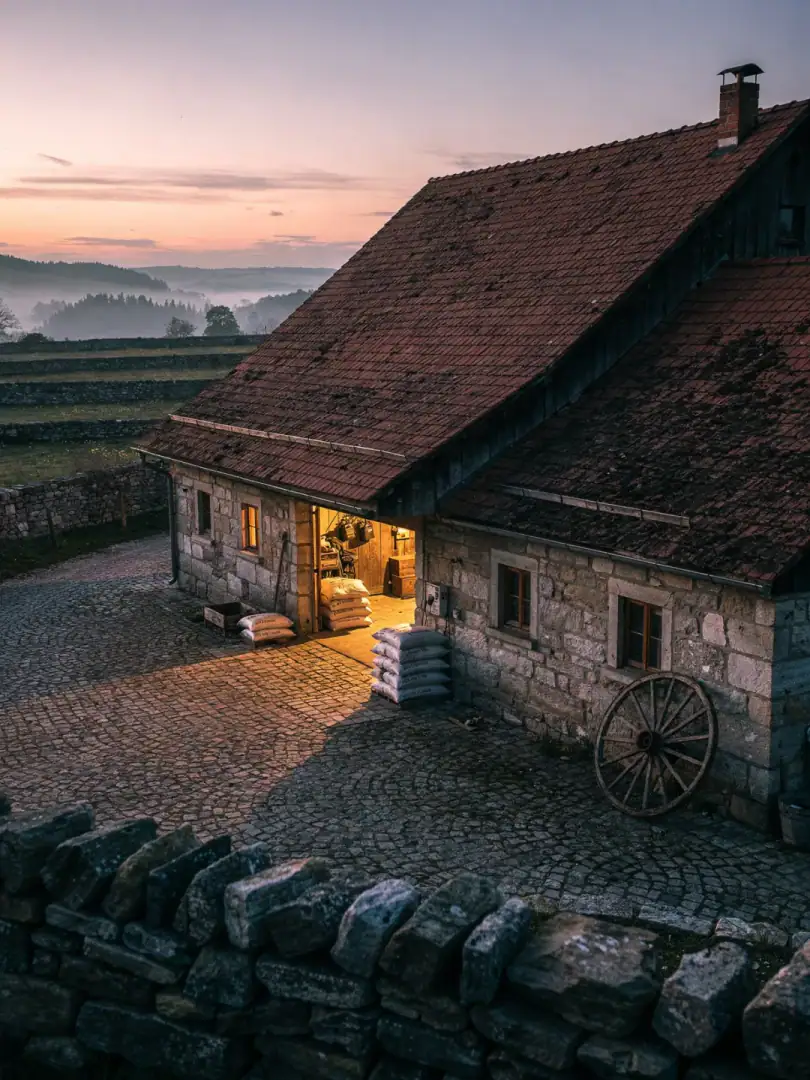
On the Hofgut Aglishardt near Nellingen, an idea took shape in the 1990s that seemed to have nothing to do with whisky at all. Farmer Hans-Gerhard Fink sold his grain to traders and began wondering why he shouldn't make more of it himself. In 1999 the first spirit ran from his still, and two years later the first finished whisky sat in the cellar: Finch was born, right in the middle of the Swabian Alb.
Things began quite differently ninety kilometers to the east, in Berglen. There, the Klotz family has been distilling since 1901 in a former inn where schnapps was already being made in 1896. Across four generations the operation stayed small: the distilling license held by the Waldhorn distillery still allows only three hundred liters of pure alcohol a year. Since 2013 the family has also used it to bottle its own whisky, called Glen Buchenbach.
In the Black Forest, the road to whisky ran by way of fruit. In Oberkirch, the Bishop of Strasbourg allowed farmers to distill their cherries into schnapps as early as 1726, partly for tax reasons and partly out of sheer need. That permission grew into one of the densest clusters of distilleries in Germany: Oberkirch today holds around 800 distilling licenses, more than any other town in the country.
Two family businesses from this tradition eventually took the leap into grain spirits. The Wild distillery in Gengenbach has been distilling fruit brandy since 1855 and is now the most decorated distillery in the Black Forest. At the Kinzig distillery, run by the Brosamer family in Biberach and specializing in fruit brandies since 1937, Martin Brosamer distilled his first single malt out of pure curiosity in 2004.
There's no dedicated German whisky law. Since May 2021, every distillery in the country has followed the same EU regulation that also binds Scotland and Ireland: whisky may not be sweetened, must come from agricultural alcohol, and needs at least three years in a wooden cask. Within that narrow framework, each of the four distilleries tells its own story.