License and Revival
Region & History
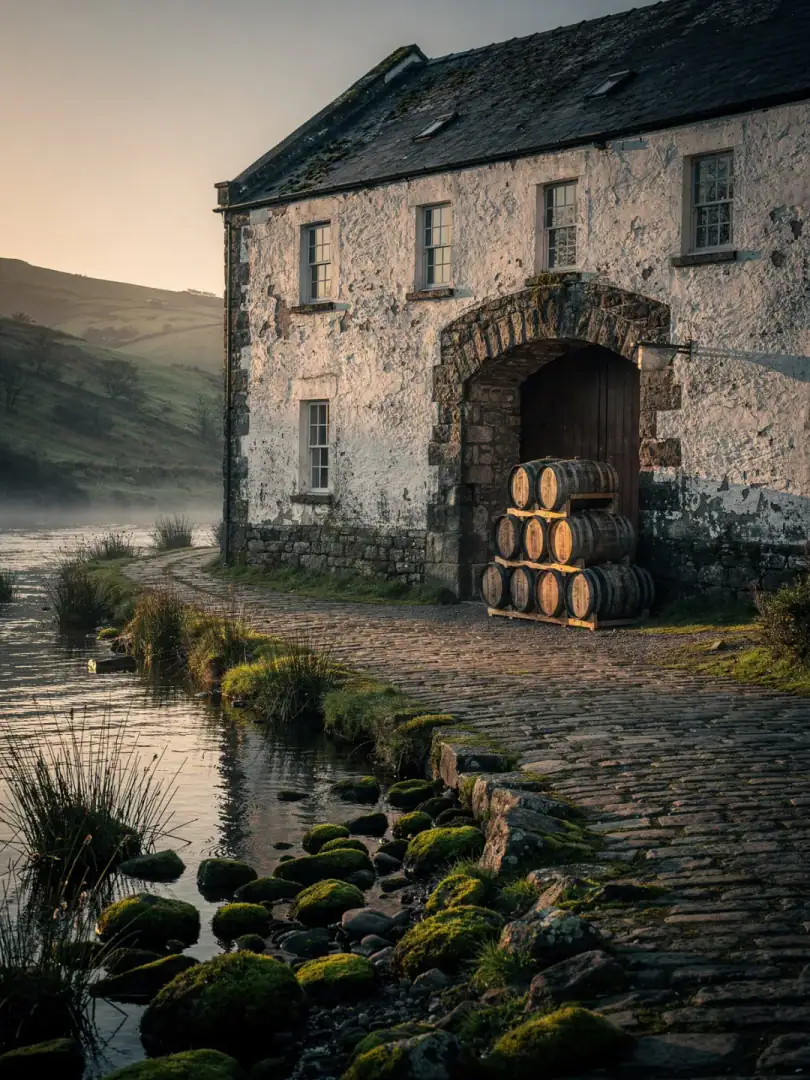
In 1608, King James I signs a license for Sir Thomas Phillips to produce grain spirit in the area around the River Bush. This year still appears on every bottle from Bushmills today, even though the distillery still operating there wasn't founded until 1784, under the name Old Bushmills Distillery. Nearly two centuries lie between the license and the build, during which distilling had long taken place in the Bush valley, just without a permanent home.
In 1785, the British Crown imposes a separate tax on malted barley. Distillers across Ireland find a workaround, mixing unmalted grain into the mash, partly out of thrift and, as some say, because they simply preferred the result. In Belfast, this grows into an empire: in 1869, John Dunville builds the Royal Irish Distilleries with five pot stills and later a Coffey still, eventually reaching an annual output of over 2.5 million gallons.
As large as Dunville's grows, the brand fades away just as quietly. In 1936, it goes dormant, and one by one, the other houses in the area disappear along with it. County Down once counted seven whiskey distilleries; by the mid-20th century, none remained. Only Bushmills holds on, even though a fire in 1885 nearly destroys the site. From that point on, Bushmills remains the sole address in Northern Ireland still distilling, for decades to come.
Not until 2013 does that change: Echlinville, on the shores of Strangford Lough, becomes the first new distillery to receive a license in over 125 years, filling its first cask on August 5th and bringing the name Dunville's back to life. Hinch in Ballynahinch follows in 2016, founded by entrepreneur Terry Cross. The first distiller there learned his craft partly at Bushmills, a small circle coming full circle.