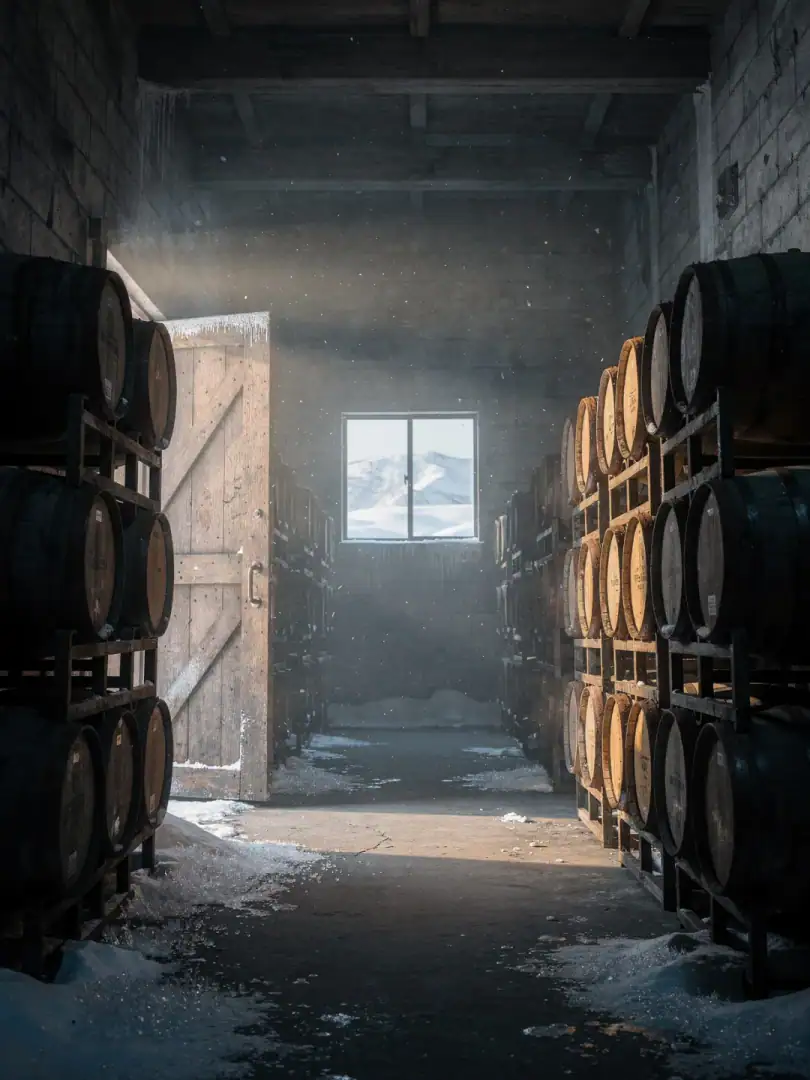
Cold, Quiet Warehouses
Cask & Maturation
By law, a cask needs at least three years to earn the label "Japanese Whisky" in Japan. Add to that: wood, a maximum capacity of 700 liters, all per the JSLMA standard set in 2021. On Hokkaido, that often means far more years than required, because here everything moves more slowly.
The island is colder than the rest of Japan, with long winters and cool summers. Casks breathe less in the cold. Whisky and wood exchange character more slowly here than in, say, Chichibu or Osaka, where hot, humid summers speed up maturation and let more liquid evaporate, the so-called angels' share.
In Yoichi's warehouses, the casks mostly rest in simple, unheated halls, closer to the weather outside than to any climate-controlled cellar. That's exactly how Nikka wants it. The swing between cold winters and mild summers is meant to work the whisky, just at its own pace.
The wood used in the cask varies from bottling to bottling. American oak, previously seasoned with bourbon, is common; European oak with a sherry past appears less often. Both lend the whisky notes of vanilla, caramel, or dark fruit, depending on what filled the cask before.
Akkeshi turns the waiting period into a system all its own. Its standard range is named after the twenty-four microseasons of the old Japanese calendar. Each bottling corresponds to a different point in the year, from the first frost to cherry blossom season, so the label itself tells you which season the cask was filled in.