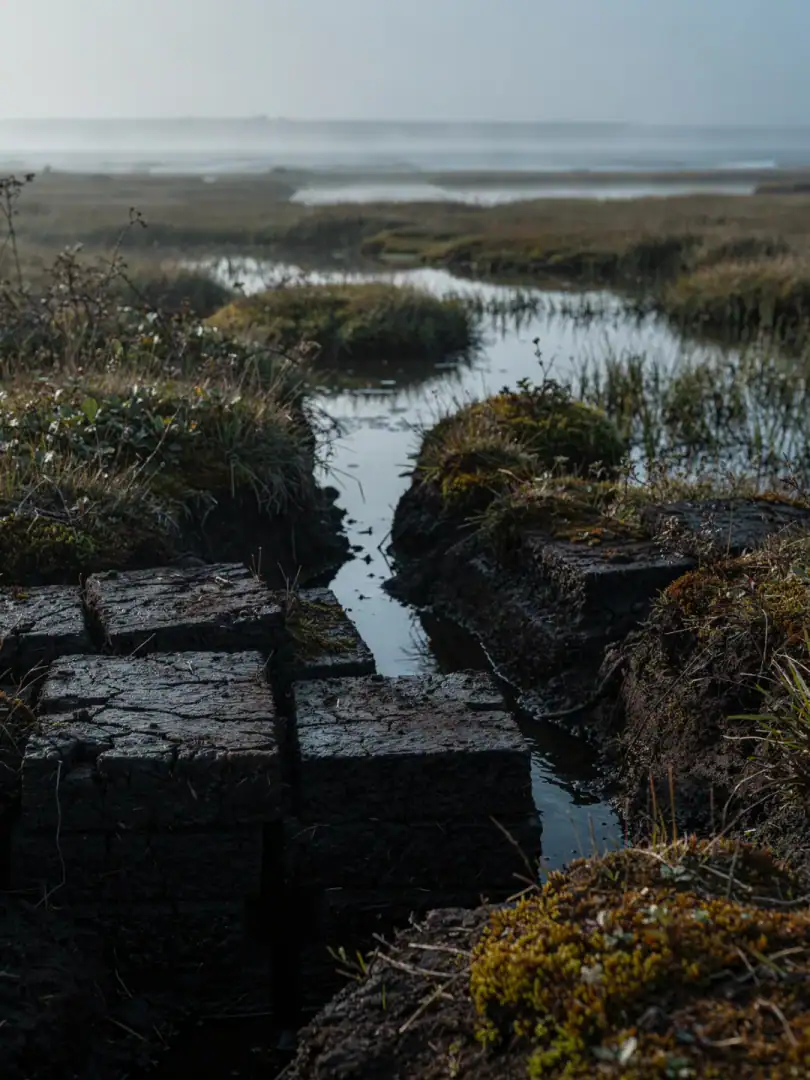
Peat from the Bog
Malt & Peat
The peat here lies in the ground itself, not shipped over in a sack from Scotland. The Ishikari Plain near Yoichi ranks among Japan's largest peatlands. Much of it has been drained for farmland over the decades, but enough peat remains to smoke barley.
During malting, the barley first steeps in water until it germinates and converts starch into sugar. It then goes onto the kiln, a heated floor with smoke drawn up through it. If peat burns below instead of wood or gas, the smoke infuses the grain as phenols, and this smoky character survives all the way to the bottle.
Yoichi has distilled a heavily peated release for decades, listed by Nikka itself as "heavy peat." The distillery doesn't publish exact phenol levels, but one thing is certain: the smoke still comes through clearly even after years in cask.
Akkeshi takes the idea further, building right on top of its own bog. Beneath the distillery, measured from 1.7 meters down, lies a peat layer 1.2 meters thick. It's almost like a second Islay, only found in Japan rather than imported from it.
Hokkaido has no major malting house of its own yet. Malted grain therefore usually comes from elsewhere, often Scotland, where maltsters can dial in the desired peating level precisely. What the region itself contributes is the peat used for its own smoking, along with the cold, damp air that helps lock the smoke into the malting floor.
Damp, dark soil made of marsh grass and sediment, the kind that covers the coastal land around Akkeshi.
The root: It holds water like a sponge, and it's underneath this layer that the true peat forms.