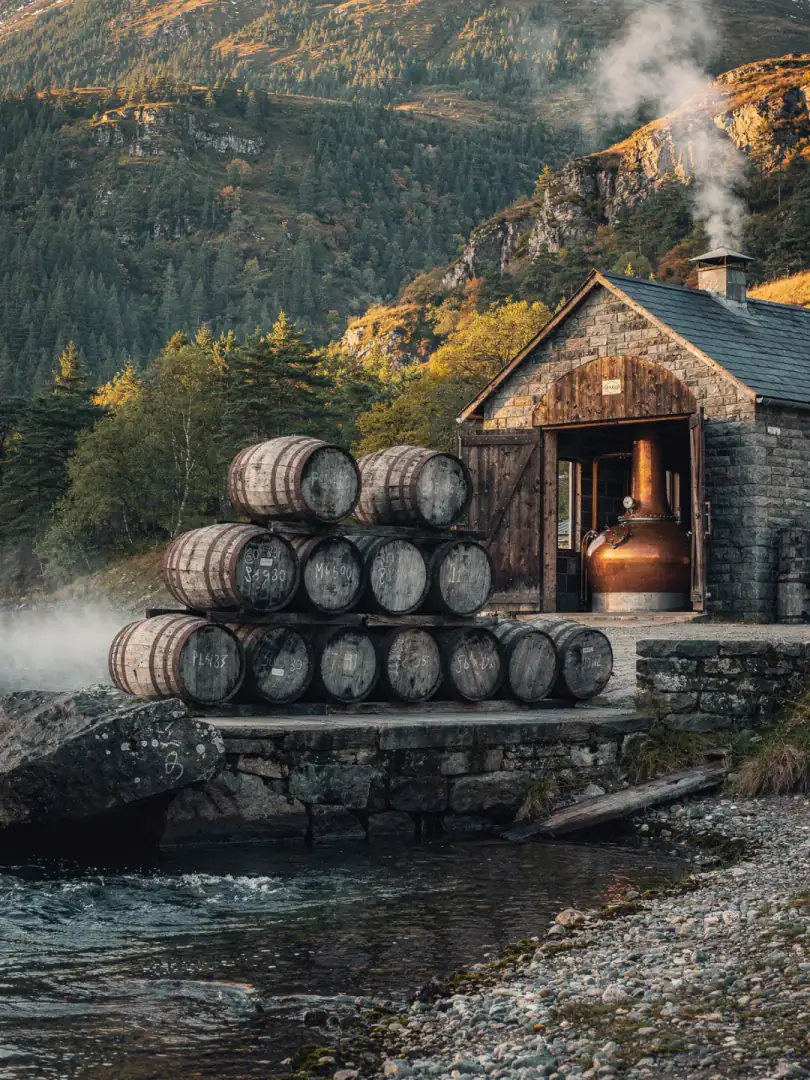
35 Years of Silence
Region & History
When people think of Japanese whisky, they often picture just one image: a distillery near Kyoto. Central Japan lies elsewhere, up in the mountains. Four distilleries are scattered across Yamanashi, Saitama, Nagano and Shizuoka, each above 600 meters and drawing on its own water straight from the rock.
Suntory opened Hakushu in 1973 as its second malt distillery, fifty years after the first. Japan's postwar boom had driven whisky demand so high that one plant was no longer enough, so the company went looking for a place with pure water and found it at Kaikomagatake in the Minami Alps.
Not every distillery in the region had such a smooth start. The Hombo family had been distilling in distant Kagoshima since 1949, moved to the Central Alps in 1985 and founded Mars Shinshu there. Right in the middle of the upswing, Japan's economic bubble burst in 1992, forcing the distillery at the foot of Komagatake to close. It sat empty for nineteen years before restarting in 2011.
Chichibu tells the opposite story. Ichiro Akuto, born in 1965 and raised in Chichibu, watched as his family's distillery, casks and all, was sold off. He bought back the remaining casks, founded Venture Whisky in 2004, and in 2007 became the first person in thirty-five years to receive a new distilling license in Japan.
Legally, "Japanese whisky" was an empty phrase for a long time: until 2021, almost any bottle could carry the name, even if it had only been bottled in Japan. The industry body JSLMA therefore set rules that took effect in 2024: malt and water from Japan, maturation in casks up to 700 liters, aged at least three years. Today Hakushu, Chichibu, Mars Shinshu and Fuji Gotemba stand side by side, each with its own answer to the same question.