Illegal Highland Distilleries
Taxes and Smuggling
As soon as the state realized that money could be made from whisky, taxation followed – and with it, a centuries-long grey area. At one point, more people were distilling illegally than legally in the Scottish Highlands, while customs officers and smugglers played a cat-and-mouse game that still shapes whisky culture today.
Taxes Make Distilling Expensive
In 1707, Scotland and England united to form the Kingdom of Great Britain. With the Union came the English tax system as well, extended to the north. A levy was initially imposed on malt, meaning germinated and dried barley. Later, a separate tax on the still itself was added, the so-called wash still tax. Anyone who wanted to distill legally paid according to the size of their still. How much they actually produced played no role in the amount owed. A still therefore incurred the same tax whether it ran full to the brim or stood half-empty.
For small Highland farms, this system was ruinous. They only distilled small quantities for their own needs and for the next market. Even so, they could barely afford the still tax, since it applied regardless of yield. Larger distilleries in the flatter, more prosperous Lowlands, on the other hand, coped far better with the same tax, since they produced in large volumes and could spread the levy across many bottles. At the same time, Scotland's tax authority sat far to the south, in Edinburgh, while the small distilleries were located in remote Highland glens. Under these conditions, enforcement was barely possible. This exact gap gave rise to an entire shadow economy.
A Whole Region Distills in Secret
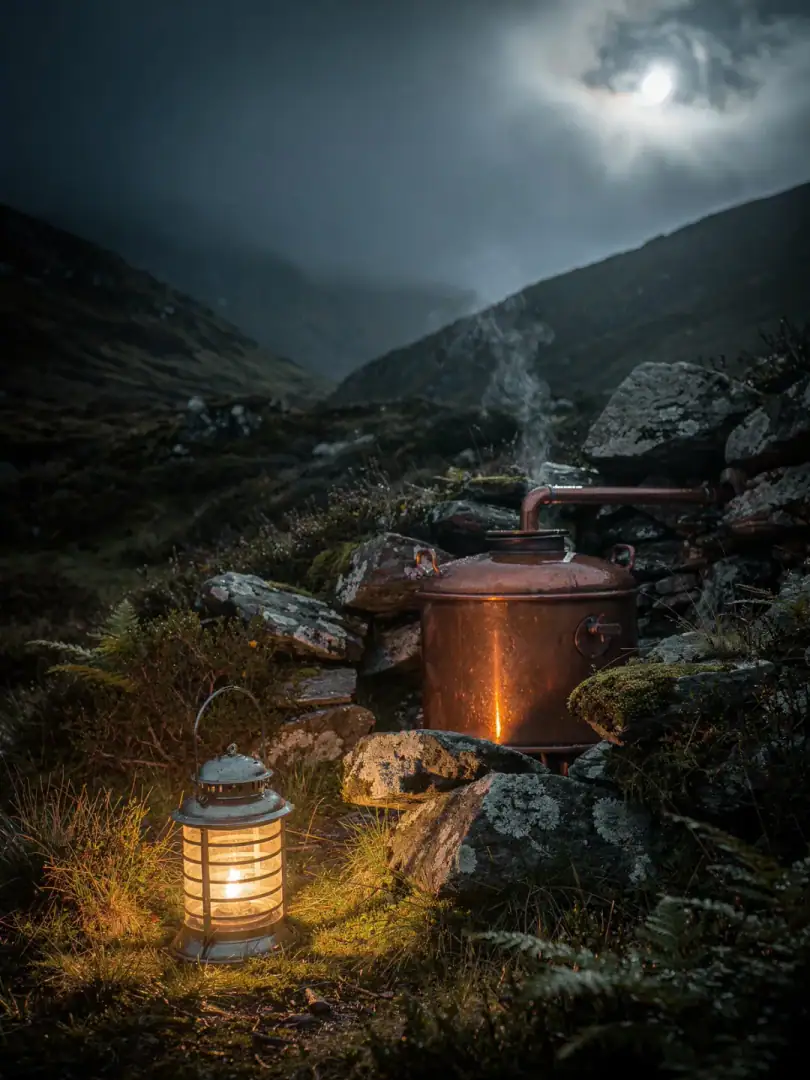
Toward the end of the 18th century, it was estimated that well over half of the whisky drunk in the Scottish Highlands came from illegal stills. Some historians assume the share was even higher. Farmers hid small stills in caves and behind waterfalls. Often these hiding places lay deep in the heather, far from any path an excise officer could take on horseback. The peat smoke that is considered a stylistic signature today was often simply practical back then: it gave away the fire less easily than bright wood smoke and could easily be mistaken for the scent of the surrounding moors.
Smuggled whisky was carried into the towns at night along smuggling trails. Men, and sometimes women, carried it hidden under hay or in the false bottoms of carts. Entire families lived off smuggling for generations, passing on their knowledge of hiding casks and evading revenue officers to their children. Many legends surround this period, some exaggerated, some well documented. What's certain is that the struggle between tax authorities and smugglers dragged on for over a century, without either side ever fully winning.
Excisemen Against Smugglers
The state sent tax investigators, known as excisemen, into the Highlands. They were empowered to search farms and confiscate stills. In many villages, they were regarded as enemies rather than as keepers of order. Anyone who informed on a smuggler had to expect ostracism in their own community, sometimes even open violence. Some officers accepted bribes, others were threatened or driven off. Still others spent entire careers in bitter resistance against the organized evasion of tax, taking on personal risk in doing so.
The most famous case concerns, of all places, an address that would later become entirely legal: along the River Livet in the Highlands, over a hundred illegal stills operated, hidden in glens and caves. One of their operators, George Smith, eventually decided to switch sides. His story already belongs to the next stop on this journey, for it begins only with a law that fundamentally changed the equation for everyone involved.
A Century in a State of Emergency
Looking back, the age of the smugglers was no marginal phenomenon. For over a hundred years, it was the reality of Scotch whisky, not the exception to it. It shaped how whisky was made, hidden and transported. And it left behind a self-image that is still cherished today: whisky as a drink of resistance against authority, distilled by ordinary people, not by some distant industry.
For the state, however, the situation was ultimately untenable. Tax revenue was lost because so much whisky bypassed the till entirely. Tensions between officers and farmers kept rising, sometimes to the point of open confrontation. At the same time, the quality of illicit spirit varied wildly, since no one controlled it. Something had to change. In 1823, almost everything changed at once.