Water of Life
The Origin
The name whisky comes from Gaelic and means water of life. Monks brought distilling to Scotland long before anyone thought of turning it into a business. The oldest written record is over five hundred years old – an entry in a royal account book.
Where the Name Whisky Comes From
Monks and scholars once translated the Latin aqua vitae into Gaelic: uisge beatha, water of life. As early as the 16th century, the word appeared in English travel accounts, usually described as an exotic curiosity from the Celtic Highlands. To English ears, the term sounded foreign and barely pronounceable. Over the centuries, the pronunciation was gradually worn down. Uisge became usquebaugh, and usquebaugh eventually became whisky. English officials and traders, who had little grasp of the Gaelic language, shortened the unwieldy term to the one word that has stuck to this day.
The very same root lies behind the Irish word uisce beatha, and that's exactly where the double spelling comes from that still causes confusion today. Scotland spells it whisky, without an e, while Ireland and the US mostly spell it whiskey. Canada and Japan later adopted the Scottish spelling, because their first distilleries modeled themselves on the Scottish example. Both countries of origin claim to have invented the drink. Neither side can prove it conclusively, because the knowledge of distilling traveled across the sea long before anyone kept records of it. Among whisky fans, this question is still debated with great enthusiasm today.
Monks Brought the Art of Distilling
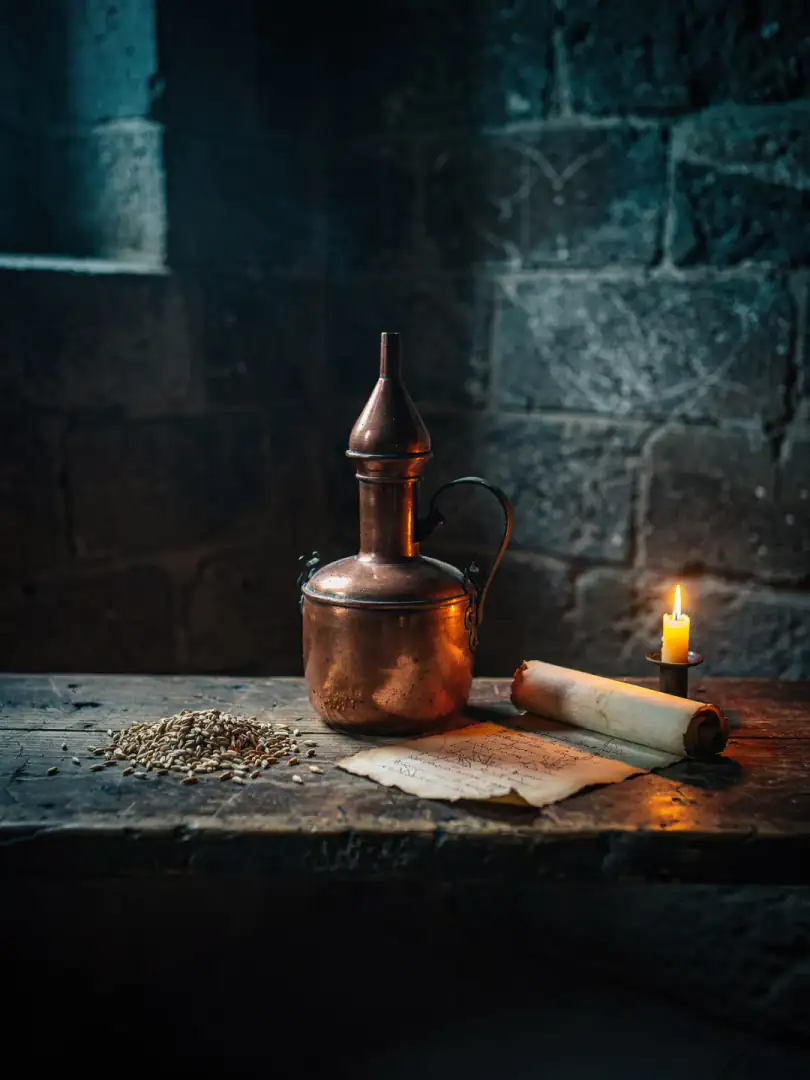
The technique of extracting high-proof alcohol from a liquid did not originate in Scotland. It came via trade routes from the Mediterranean, where physicians and alchemists distilled wine and herbs to produce medicine. Many monasteries ran their own small apothecaries, where spirits, tinctures and salves were produced. Traveling monks carried this knowledge along pilgrimage routes across Europe. Monasteries had the necessary knowledge for this, along with time, books and the copper vessels known as alembics. When Irish and Scottish monks came into contact with this knowledge, they applied it to what grew abundantly in their own land: barley.
Unlike grapes in the south, Scotland and Ireland are rich in grain and water from clear springs. The same trick used with wine could therefore be applied to fermented barley mash. The result was initially not meant for enjoyment but for medicine. Physicians administered the spirit against colic, smallpox and almost every other ailment, often just drop by drop, mixed with herbs or honey. Some, however, quickly noticed how pleasantly warming a sip could be on cold winter days. It was only over generations that this medicine turned into a drink people enjoyed even without being ill.
The Exchequer Roll of 1494
The oldest written record of Scotch whisky appears in a royal tax record, the Exchequer Roll of 1494. There, a scribe notes that a monk named John Cor received eight bolls of malt on the order of King James IV, to make aqua vitae from it. One boll amounted to roughly 140 kilograms of grain – no small quantity for a single order. Eight bolls of malt were enough for several hundred bottles. This wasn't an experiment, but already a proper production run for the royal court. The document is still held today in the National Records of Scotland and is one of the most frequently cited pieces of evidence in whisky history.
This line doesn't prove that 1494 was the birth year of whisky. It only proves that by this point, enough was already being distilled to be recorded in tax documents. Distilling had likely been going on for decades longer, just without anyone writing it down. Historians suspect that similar orders were common even before 1494, simply not appearing in surviving records. For whisky history, though, the entry remains the fixed point that every later account refers back to.
From the Monastery to the Farmhouse
In the 16th century, the Reformation hit Scottish monasteries hard. Many were dissolved or lost their lands. The monks who had mastered distilling didn't disappear along with them. They passed their knowledge on to the rural population, among whom they often found refuge. Some former monks became farmers themselves and began distilling on their own account. From then on, whisky was no longer a monastic privilege but part of everyday rural life.
Farmers distilled small quantities from surplus barley, which otherwise stored poorly, for their own use or to sell at the next market. A simple copper still, heated over an open fire, was entirely sufficient for household needs. Almost every farm in the Scottish Highlands eventually had its own small still. This situation persisted quite well until the state began to see this craft as a source of revenue. And that's exactly where the next stop on this journey begins.