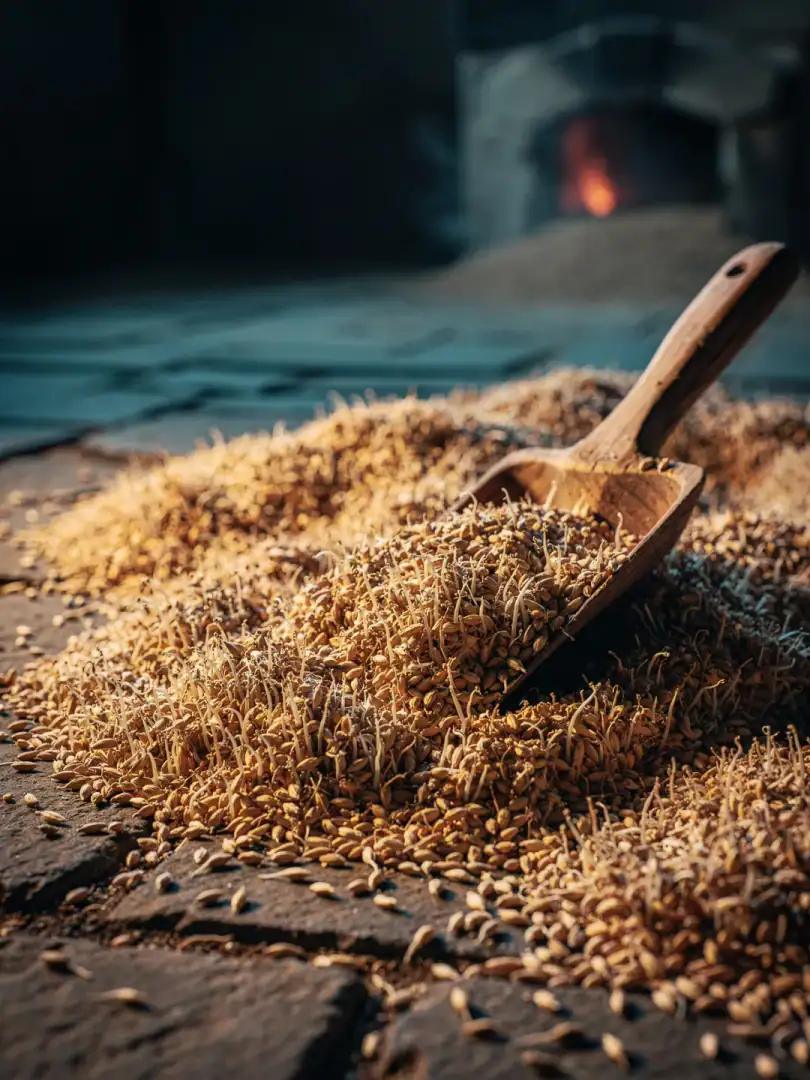
Grain Wakes Itself Up
Malting
Before a distillery produces a single drop of alcohol, the grain first has to be coaxed into converting its own starch into sugar. This is called malting.
Why Barley Has to Germinate First
Raw barley consists largely of starch. Yeast cannot process this starch directly. Only when the grain germinates does it form enzymes, chiefly amylase. These enzymes later break down the starch into fermentable sugar. It's these enzymes the distillery actually needs, not the sprout itself. Without them, the mash would be low in sugar and the yeast would have little to work with.
This is why barley is first soaked in water several times. Its moisture content rises to over 40 percent during this process, known as steeping. Depending on the grain and the distillery, it takes one to two days. After that, the barley moves to the malting floor or into a drum. There it continues to germinate under controlled temperature and airflow, usually for four to seven days.
During germination, a small white rootlet sprouts from each grain. This shows that enzyme formation is under way. Too little moisture slows the process down, too much causes the grains to clump together. Experienced maltsters check progress several times a day, using nothing more than their eyes and nose.
From the Malting Floor to the Industrial Maltings
In the past, germinating barley was spread across flat stone floors, the malting floors. Workers turned it with wooden shovels so the heat of germination wouldn't build up. The fine rootlets also had to be kept from matting together, or oxygen would stop flowing through the pile. This work was physically demanding and had to continue around the clock.
A handful of Scottish distilleries keep this handcraft alive today, among them Balvenie, Highland Park and Springbank. Even so, it usually covers only part of their needs, with the rest bought in as well. Most malt today comes from industrial maltings, where giant germination drums control temperature and airflow automatically and precisely.
This delivers more consistent quality and far greater volumes. The distillery, however, loses direct control over this first step. Both paths ultimately produce malt. Only the effort involved and the craftsman's touch differ, and for many house styles, that difference matters a great deal.
Timing Is Everything: Stopping Germination
After four to seven days, the barley has formed enough enzymes. But it must not be allowed to keep germinating, or it will consume the very starch it has just unlocked, leaving the distillery short of sugar later on. This is why it's dried with hot air in the kiln. Moisture content drops from over 40 percent to around 4 to 5 percent.
This dried malt is called green malt while it's still fresh off the kiln. Drying makes it stable and storable. Without this step, the grain would quickly mold or keep germinating, and be lost to the distillery entirely.
During kilning, the hot air can be infused with peat smoke. This is what gives the later whisky its smoky character. Exactly how strong that smoke turns out, and how it shows up in the finished whisky, is a whole subject in itself. For now, it's enough to note: the decision for or against peat is made right here at the kiln, long before the mash even exists.
What Finally Goes Into the Mill
After kilning, the finished malt is cleaned. Dust and root fragments are removed. It's then often stored for several more weeks to let moisture and enzyme content even out. Only then does it leave the maltings for the distillery, often travelling hundreds of miles by truck. Very few distilleries still malt their own barley today.
A lot can already be read from the malt itself. Its color shows how heavily it was smoked. Its smell reveals whether it was stored clean and dry. A good maltster can often spot quality problems before a single grain ever reaches the mill.
For the distillery, malt is the raw material where everything begins. For the drinker, it's later just one of many ingredients that can no longer be tasted individually in the glass. Even so, every decision made during malting carries through to the very last sip.