Sugar From the Grain
Milling & Mashing
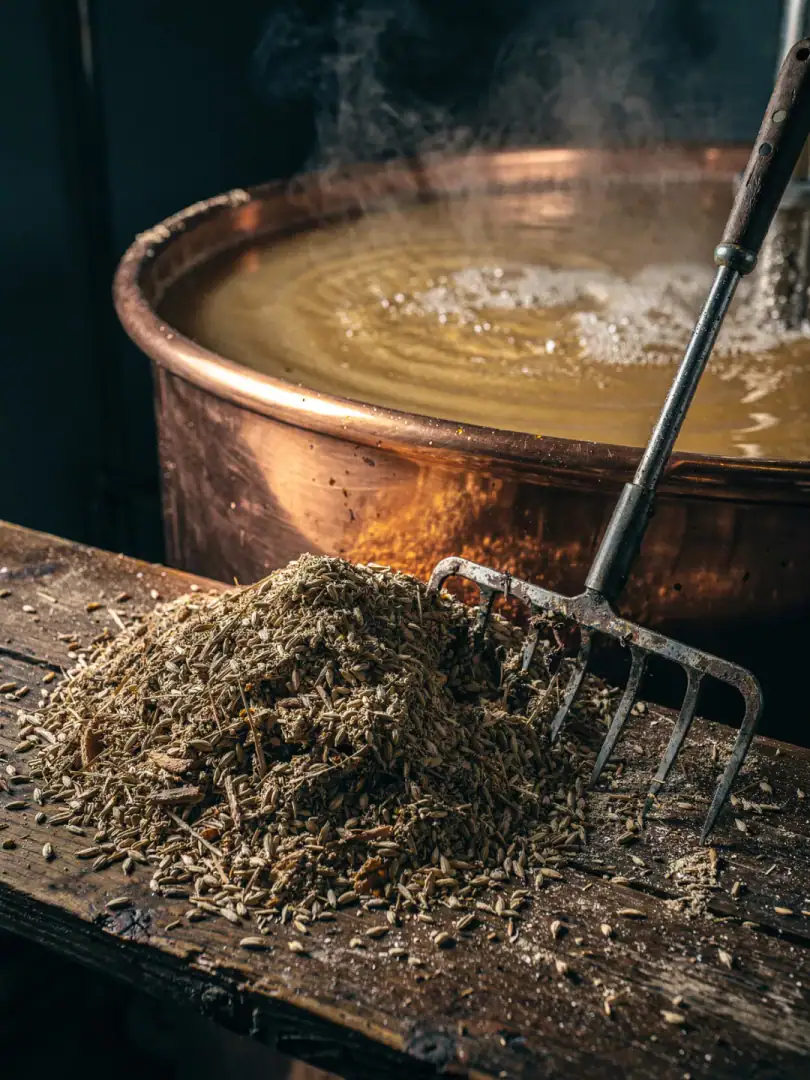
Before yeast can even get to work, the distillery first has to extract a sugar-rich liquid from the finished malt. For that, the grain is ground and washed with hot water.
The Mill Strikes a Fine Balance
The dried malt first passes through a grinding mill. Many distilleries still rely on decades-old models from the British manufacturer Porteus. The mill breaks the grains down into grist. Grist is a mixture of coarse husk, medium-fine grits and fine flour, typically in a ratio of about 20 to 70 to 10.
This mixture is no accident. Too much flour later clogs the mash tun, slowing down the lautering of the wort considerably. Grain ground too coarsely, on the other hand, releases too little sugar, lowering the yield. Every mill is therefore adjusted regularly, often with a simple sieve test that re-weighs the three fractions and immediately shows if something has shifted.
Some Porteus mills have been running in the same building since the 1950s or 1960s and were never replaced with a newer model, since the manufacturers no longer exist and each distillery has to maintain its own machine. At some distilleries, a dedicated mill engineer is part of the permanent staff, because a breakdown would instantly throw the entire production schedule into chaos.
Three Waters in the Mash Tun
In the round mash tun, the grist is mixed with hot water. Rotating arms stir the mixture slowly. Three separate waters at rising temperatures are typical. The first runs at about 63 to 67 degrees Celsius, the second at 70 to 80 degrees, and the third close to boiling point.
Each water draws out further sugars that earlier waters hadn't reached. The clear, sweet liquid that drains off is called wort. It's drawn off through a sieve at the bottom of the tun after each water.
The last, hottest water is usually not used right away. Instead, it serves as the first water for the next batch. This way, as little sugar as possible goes unused, and the distillery makes the most of its raw material.
Draff Stays Behind, Wort Moves On
What remains at the bottom of the tun is called draff, a moist, protein-rich spent grain. It almost always ends up as animal feed for local farmers, since it spoils quickly and isn't worth transporting far. Some distilleries also press it to extract dry matter for pellets.
The drawn-off wort is then cooled. Hot liquid would kill the yeast instantly in the next step. Only once it reaches around 20 degrees is it ready for fermentation. Up to this point, not a single percent of alcohol has been created. All that exists is pure, sweet sugar dissolved in water, waiting to be put to work.
Larger distilleries often supply their draff to fixed buyers nearby, sometimes via pipeline rather than truck, which does away with the need for daily transport. It's economically worthwhile for both sides, since farmers save on feed costs and the distillery doesn't have to dispose of the spent grain itself.
Why Mashing Works Differently for Bourbon
Bourbon and rye don't start with pure malt. They begin with a grain blend known as the mash bill. Corn or rye makes up the bulk of it, with only a small proportion of malt supplying the necessary enzymes. Cooking often takes place in pressure cookers, since corn contains far tougher starch than barley.
Even so, the basic principle stays the same. Starch is broken down into sugar, and only then can yeast turn it into alcohol. How differently malt, corn and rye proportions ultimately taste is best seen in a direct comparison between American and Scotch whisky.
A typical bourbon mash bill contains roughly 70 percent corn, along with rye or wheat plus a small proportion of malted barley for the enzymes. Rye whiskey flips that ratio, using at least 51 percent rye, which gives the grain its characteristic spicy, slightly sharp note.
Modern Mash Filters Instead of the Classic Sieve
Alongside the classic mash tun, some modern large-scale operations now use what's called a mash filter, such as Diageo's giant Roseisle distillery in Speyside. Instead of lautering the wort through a sieve at the bottom of the tun, this technology presses the grist through fine filter plates, yielding an especially clear, solids-free wort.
This boosts yield and dramatically speeds up throughput, since a mash filter can run several batches a day, where a traditional mash tun takes considerably longer. Critics counter that the extremely clear wort carries fewer fatty acids, which means fermentation behaves somewhat differently than in a classic tun.