Column instead of doubler
Distillation
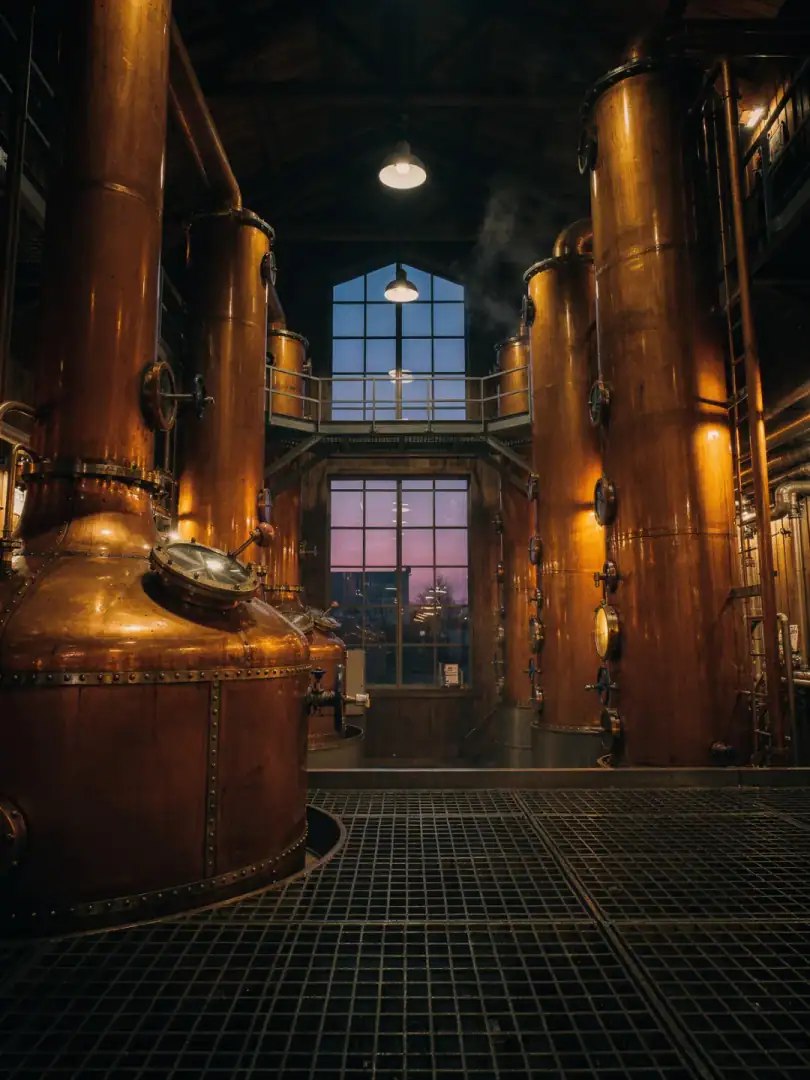
Six copper columns in Lynchburg turn fermented mash into raw spirit, two of them nearly two meters in diameter. That makes the distillery the largest whiskey producer in the US. Unlike a Scottish pot still, which works in batches, the column runs continuously. Distiller's beer flows in at the top, steam drives it up through the copper plates. What drips out at the end is a spirit that has already shed much of its sulfurous harshness. The copper plates themselves don't last forever. They're replaced every three to four years, and a whole column after roughly ten years.
Many American whiskeys pass through what's called a doubler after the column, a second small still for one final polish. Jack Daniel's skips this step. The spirit goes straight from the column into the maple charcoal, at around 140 proof, well below the legal ceiling of 160.
At Cascade Hollow near Tullahoma, George Dickel takes a step no one else in the region takes. The fresh spirit is chilled before it reaches the charcoal. The idea goes back to George A. Dickel himself, who noticed that whiskey distilled in winter tasted rounder than that made in summer. Today, the chilling mainly ensures consistency. Every batch hits the same charcoal at the same temperature, whether it's January or July outside.
In Nashville, Corsair distills a third path. The distillery skips corn as its primary grain and skips maple charcoal entirely too. Their American single malt isn't meant to qualify as Tennessee Whiskey at all. Distillation happens in copper pot stills, the kind more associated with Scotland, usually double distilled.
In the end, the same decision matters at every one of these distilleries: knowing when the cut changes. The harsh heads have to go, as do the heavy, oily tails. In between sits the heart of the run, which the distiller recognizes by nose and experience, not by the clock.