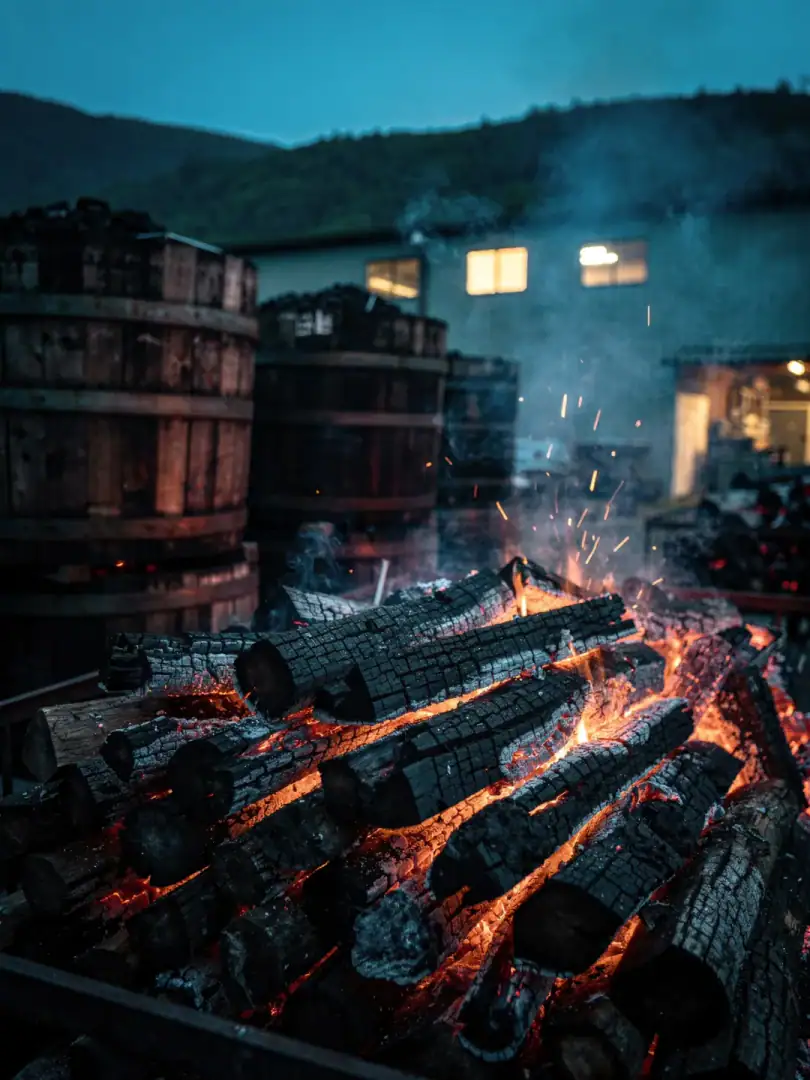
Maple instead of peat
Malt & Peat
You won't find peat in Tennessee. Beneath the state lies mostly limestone, not bog, and without bog there are no centuries-old peat layers to cut. What Scottish distilleries achieve with smoke, Lynchburg and Tullahoma achieve a completely different way: with charred maple wood.
The charcoal for this is made right next to the distillery. Stacked maple wood is burned under controlled conditions until only black, porous chunks remain, which are then crushed and packed into tall vats. There, the charcoal forms a layer several meters thick, through which the freshly distilled spirit drips before it ever sees a barrel.
The process demands patience: depending on the distillery, the spirit seeps through the charcoal for days, and some operations run it through more than once. The charcoal binds fusel oils and sulfur compounds that taste harsh and raw in young spirit. This softens it before the oak adds its own signature.
Barley plays a supporting role in the malting here: a small portion of malted barley supplies the enzymes that break down starch from corn and rye into fermentable sugar. Most distilleries source this malt from specialized maltsters in the Midwest rather than malting it themselves. Peat smoke for flavoring simply isn't part of the region's toolkit.
In the end, Tennessee Whiskey doesn't rely on a ppm smoke rating the way Scottish labels sometimes do. The measure that counts here is time at the charcoal filter and the thickness of the layer the spirit drips through, a metric no peat bog has ever needed.
Dark, fertile earth where corn, rye, and a bit of barley grow.
The root: Good topsoil supplies the grain that later makes up over fifty percent corn in the mash.