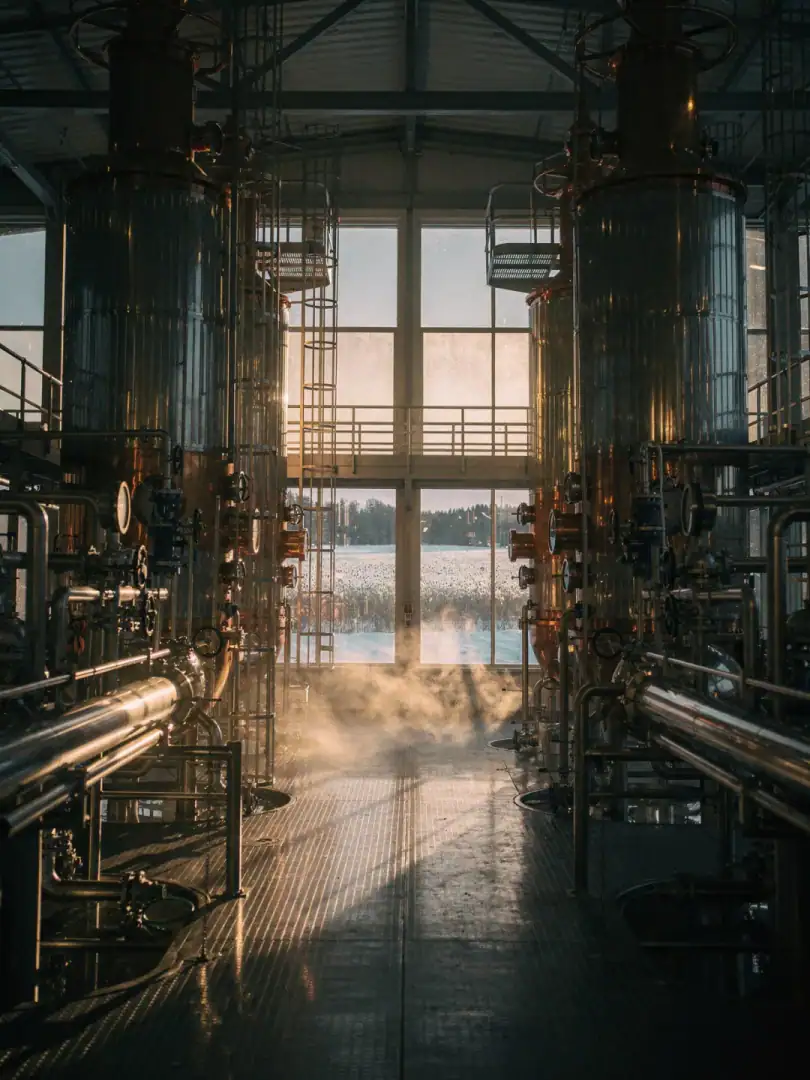
Columns from Ilmajoki
Distillation & Rectification
Fermented barley mash becomes pure alcohol in Ilmajoki. Seven columns, averaging twenty-five meters in height, form the heart of Altia's facility. They operate on a multi-pressure system, where vapor passes through several columns in sequence rather than rising just once.
Before the alcohol ever reaches the columns, fermentation must happen first: the milled barley is mixed with water to form a mash, enzymes break down the starch into fermentable sugar, and yeast turns it into a weakly alcoholic mash within one to two days.
Unlike a classic pot still, which is filled and then emptied, the facility in Ilmajoki runs continuously: mash flows in constantly, and alcohol flows out steadily at the other end of the column line. A whisky distiller using a copper pot still would produce only a fraction of this volume in the same amount of time.
Along this path, the alcohol passes through more than two hundred individual distillation steps, according to the company. This process separates out methanol, which forms in small amounts during every fermentation, along with fuel oils and other byproducts, leaving pure drinking alcohol at the end.
EU Spirit Drinks Regulation 2019/787 requires vodka to contain at least 37.5 percent alcohol by volume. Koskenkorva Viina comes in just above that at 38 percent, with versions also available at 40 and 60 percent. After leaving the columns, the alcohol is brought to drinking strength using Rajamäki's spring water and a small amount of sugar.
Finlandia, the internationally better-known sister brand, comes off the very same columns in Ilmajoki. The only difference from the 40 percent Koskenkorva is that no sugar is added to Finlandia; the rest of the recipe remains identical.