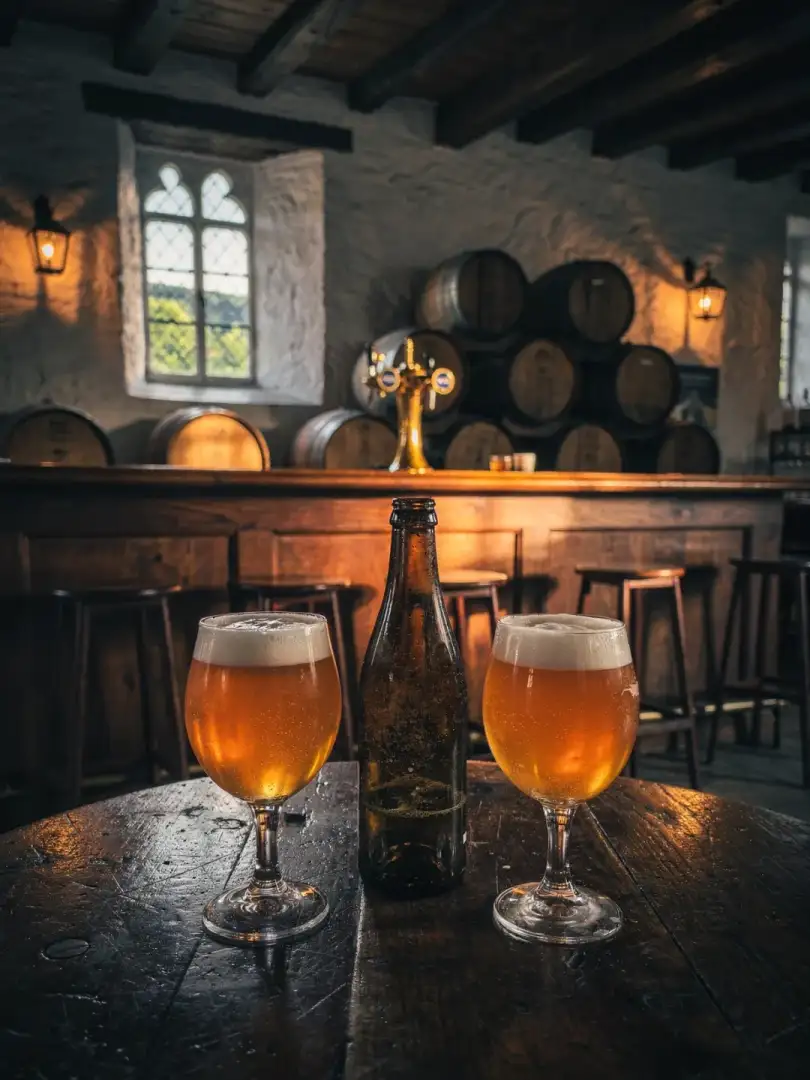
Chalice, Head, Brett
Tasting
What does Orval taste like? The beer is dry, bitter, and hoppy, with aromas of citrus peel, hay, and damp cellar. On the palate it carries a vigorous fizz, followed by a crisp bitterness, with a light, fresh acidity lingering on the finish. Sweetness barely plays a role. Anyone familiar with Dubbel or Tripel will experience the opposite here. This austerity is intentional, not a flaw — it's exactly what makes the beer such a good match for hearty food.
Three breweries serve as good examples from the Gaume. Orval itself, based in Villers-devant-Orval, essentially brews a single beer. Brasserie Sainte-Hélène in Virton was founded by Eddy Pourtois, who started home-brewing in 1995 and has brewed commercially since 1999. In Florenville stands Brasserie des Djeus, which opened in 2017 and names its beers after words from the Gaume patois.
Orval is traditionally served in a large stemmed glass, the chalice, with a wide bowl. It captures the aromas and gives the robust head room to develop. A tulip glass, which narrows again toward the top, serves the same purpose. The glass must be clean and free of grease, or the head will collapse quickly.
On temperature: Orval tastes best cool, but not ice-cold. At fridge-cold temperatures, the subtle aromas of yeast and hops disappear, while at room temperature the beer feels heavy. A bit warmer than a pilsner is a good starting point. Let the bottle stand undisturbed beforehand so the yeast can settle.
Patience helps when pouring. Hold the glass at a slight angle, pour slowly, and let the head build. The sediment stays in the bottle at first, and whether you pour it in at the end is purely a matter of taste. It makes the beer cloudier and yeastier, but not worse.