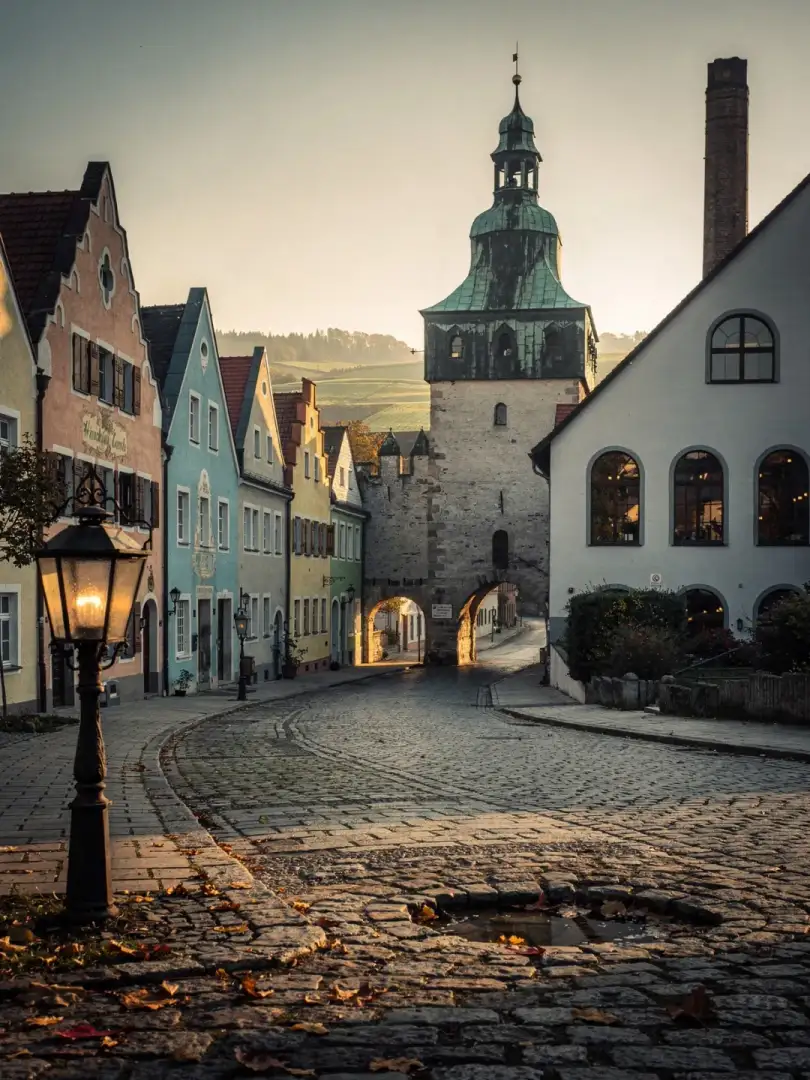
Brewhouse, then world market
Region & History
What is Erdinger Weißbräu, and why does a brewery in a county town northeast of Munich count among the largest wheat beer breweries in the world? The answer starts in 1886 with the "Weisse Bräuhaus zu Erding," an operation on Lange Zeile that brewed wheat beer for the surrounding area.
In 1935, longtime manager Franz Brombach bought the brewery. Output at the time was around 3,500 hectoliters a year, which is 350,000 liters, since one hectoliter holds a hundred. His son Werner Brombach joined in 1965, by which point output had already reached 40,000 hectoliters.
Then things moved fast. By around 1978 the brewery had reached about 225,000 hectoliters, and in 1990 it crossed the one million mark for the first time. Today the company reports around 1.5 million hectoliters, shipped to more than 100 countries. That works out to roughly 300 million half-liter bottles.
Alongside the family-owned Brombach operation, the town is also home to Fischer's Stiftungsbrauerei Erding. In autumn it hosts the second big festival tent, more on that later. Exactly how many breweries operate in the county isn't documented here, so no figure appears in the text.
There's no protected designation of origin for Weißbier. The EU register lists no Weißbier at all, and Weißbier, Weizenbier, and Hefeweizen all mean the same thing. Erding's reputation, then, rests on scale and brand rather than geography. By law, top-fermented beer in Bavaria is subject to a sugar ban, unlike in the rest of Germany.
What remains fascinating is the contrast between the large-scale operation and the small tavern brewery. One delivers consistent quality worldwide, the other a brew that tastes of the weather and the brewer.