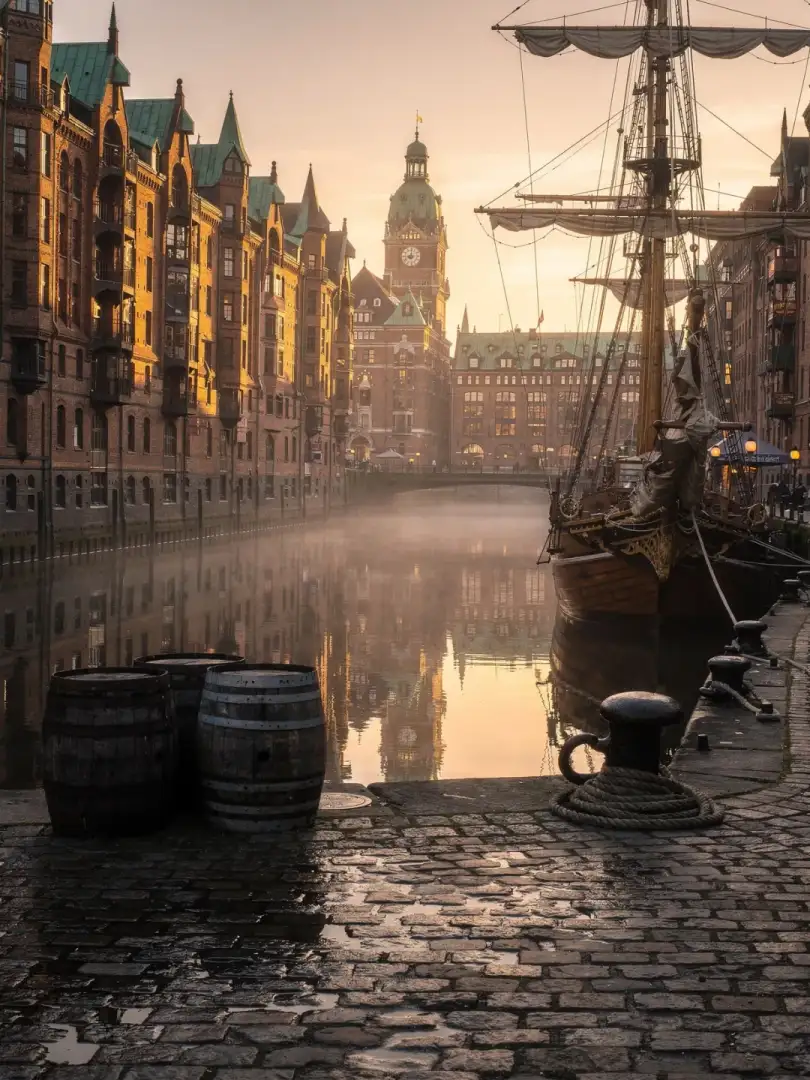
Brewhouse of the Hanseatic League
Region & History
Why is Hamburg called the brewhouse of the Hanseatic League? Because in the 14th century, the city counted around 450 brewhouses for roughly 8,000 inhabitants, and by 1540 the number had risen to 531. Beer was one of the most important export goods; in the Middle Ages, it's said to have made up about a third of all exports.
Ships carried Hamburg beer mainly to the Netherlands, but also to France, England, Jutland, and Iceland. Estimates for the peak period run as high as 574,000 hectoliters a year, though this figure isn't firmly documented.
The city council kept a tight rein on the trade. For every brew, a brewer needed the council's permission, the so-called "Orloff," and the council also decided whether the beer was destined for export or for local consumption as city beer.
Today's picture dates back to the founding era of German industry. On May 24, 1879, the Holsten brewery was established in Altona, at the time still its own city, and was planned from the start as a large-scale brewery. It later absorbed many small Hamburg breweries.
On St. Pauli, the Bavaria brewery (founded in 1897) merged with the Actien-Brauerei in 1922 to form the Bavaria-St. Pauli brewery. The Astra brand name has existed since 1909. The brewery between the Landungsbrücken and the Reeperbahn was demolished in 2003, and Astra has been brewed at Holsten ever since.
Who owns Hamburg beer today? Since 2004, the Danish group Carlsberg has owned Holsten, and with it, the rights to Astra. Ratsherrn belongs to the Nordmann Group, which acquired the brand rights in 2004 and has been brewing in the Schanzenhöfe since 2012. Unlike Bremer beer, there is no EU protected designation of origin for "Hamburg beer."