Baker's Yeast, Short Fermentation
Yeast & Fermentation
What yeast does Sahti need? The classic answer: ordinary baker's yeast. Sahti is top-fermented, meaning the yeast works at room temperature near the surface of the vat, and it can't be cleanly separated out after fermentation. Store-bought baker's yeast was long the most reliable choice on the farm.
If a farm in Joutsa or Kuhmoinen had its own yeast, it was traditionally passed from brewer to brewer, on a wooden stick, a wreath of branches, or a piece of bread. Such traditions are common among Northern Europe's farmhouse beers, though exactly how they looked in Häme can't be said for every farm. Today some brewers also turn to brewer's yeast or Norwegian kveik yeast.
Fermentation is brief. At room temperature it takes only a few days, and given the high sugar content of the wort, a lot of residual sweetness remains in the beer. That explains its full, almost syrupy body. Sahti is not a dry beer. According to BJCP guidelines, alcohol content runs from seven to eleven percent.
Little aging follows. Sahti is bottled unfiltered and unpasteurized, with the yeast remaining in the beer. It turns cloudy when poured and has almost no carbonation, sometimes none at all. It's drunk young and fresh, since it changes and declines in quality after a few weeks.
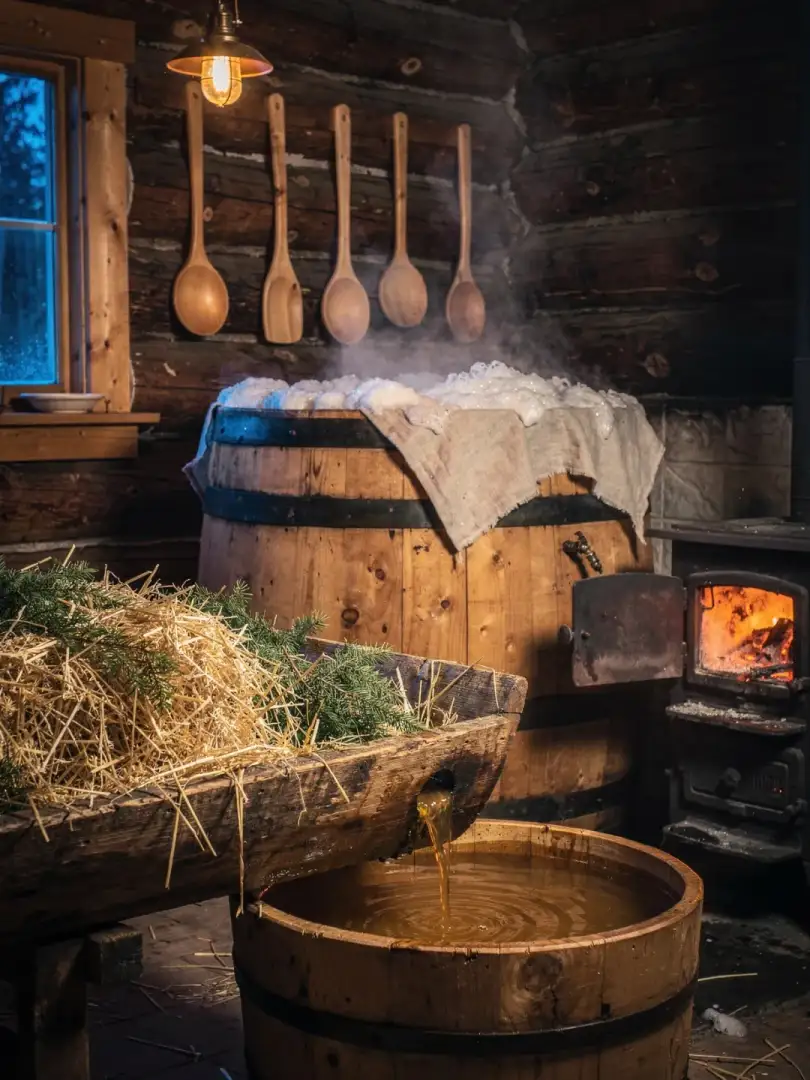
On the farm, the fermentation vessel is often simply a clean barrel or wooden tub. Brewers cover it with a cloth and set it in a cool room. There's usually no airlock. Modern breweries work with stainless steel and refrigeration but follow essentially the same sequence: mashing, lautering, pitching yeast, a few days of fermentation, bottling.