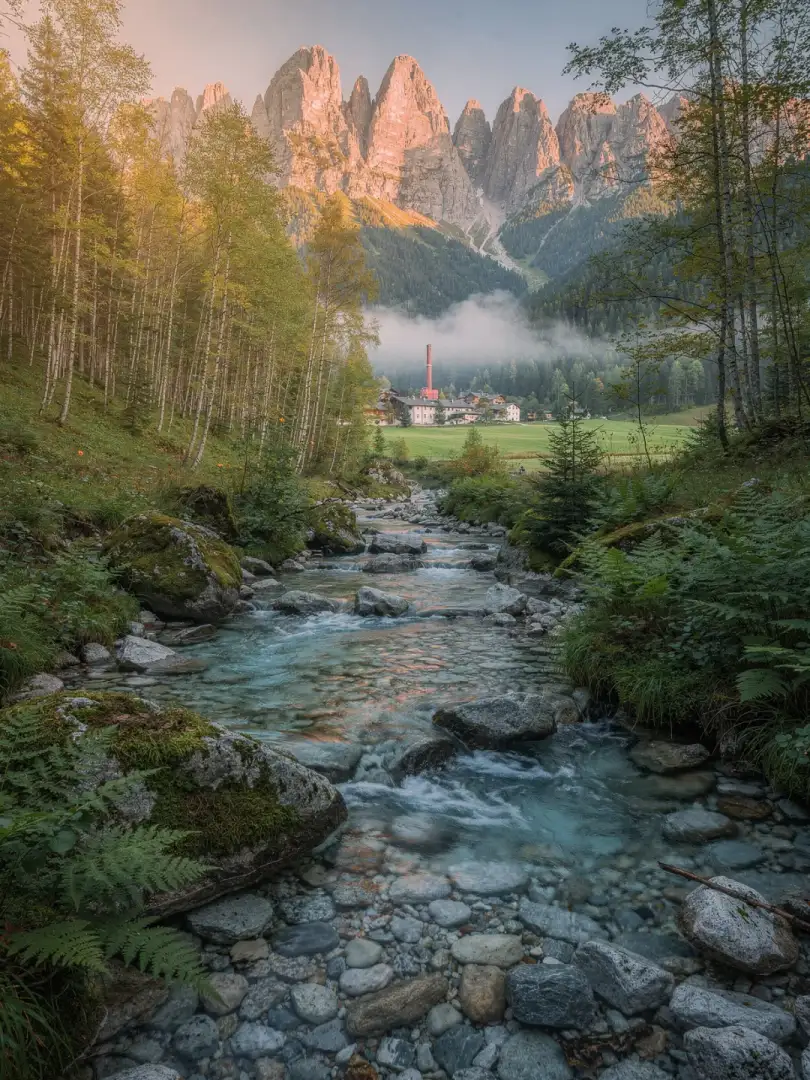
Springs at the Mountain's Edge
Water & Soil
What kind of water does a pale lager need? Soft water, ideally, since that keeps the hop bitterness mild. Hardness means dissolved calcium and magnesium salts, and too much of it quickly makes a beer taste harsh. Pedavena has relied on mountain spring water from the very start.
In 1897 the Luciani brothers searched for a location with good springs and found one at the foot of the Dolomiti Bellunesi. There, rain and meltwater seep through the mountains and emerge clear and cold. The company's history explicitly credits these springs for the choice of location.
In the north of Friuli rise the Carnic and Julian Alps, while to the south lies the flat Bassa Friulana. That's where Castello's brewery stands, in San Giorgio di Nogaro, not far from the Marano Lagoon and the Adriatic. Here the water comes from the plain's groundwater, not from mountain rock.
Even a craft brewery plays the mountain card. Birrificio Gjulia, run by brothers Marco and Massimo Zorzettig, states that it uses spring water from Monte Mia as the foundation of its beers.
The climate demands cooling. Summers on the plain are hot, and a bottom-fermented beer only ferments and matures cleanly at low temperatures. That's why Luigi Moretti combined brewery and ice factory back in 1859. Today, refrigeration units and cooled tanks do what the factory ice once accomplished. The brewery also needs plenty of water for rinsing and cooling, which is why locations near mountains or a reliable water source still offer advantages today.