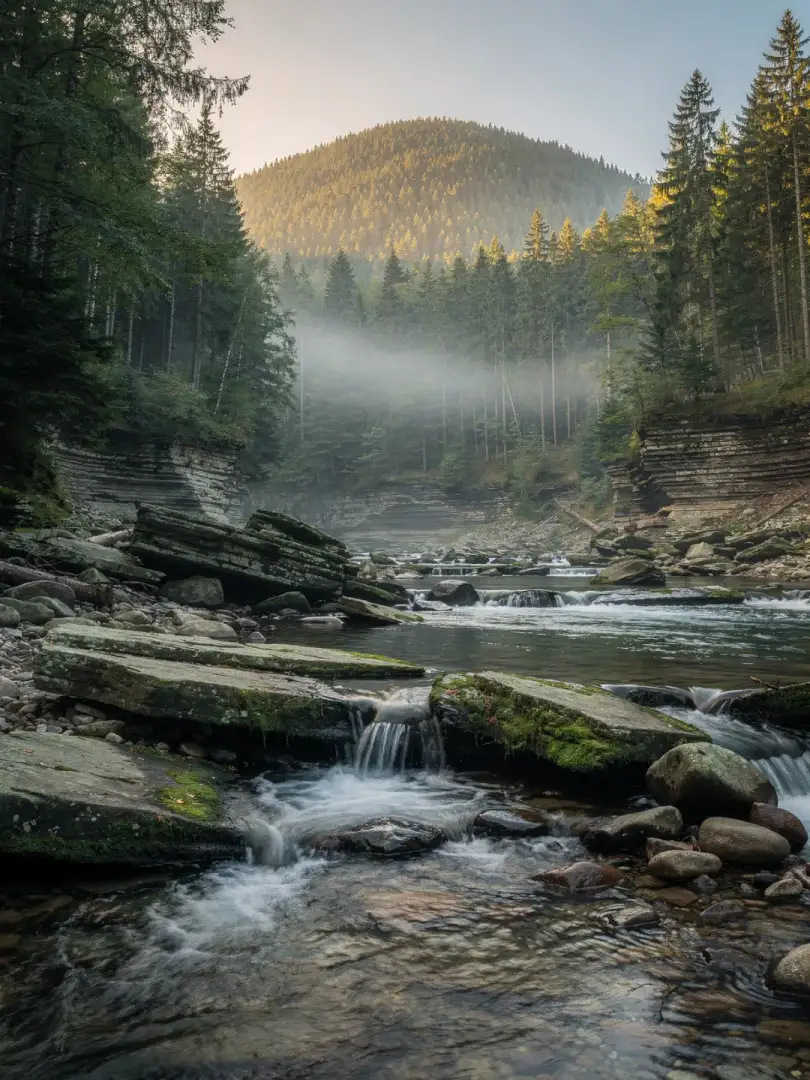
Mountain stream, flysch
Water & Soil
The brewing water for Żywiec comes from the mountains. According to the brewery's own history, spring water from the Leśnianka has been used since the 19th century — a small river that rises in the Silesian Beskids. The town lies at the confluence of several streams in the valley of the Soła, surrounded by forested mountain ridges.
The Beskids belong to the Western Carpathians. Their bedrock is flysch, a sequence of sandstone and shale clay that was deposited on the seabed millions of years ago and later folded upward. Water from such mountains is usually low in minerals, because rain and snow run quickly through sandstone and dissolve little lime. This is a general rule of thumb, not a brewery measurement.
What does the water do to the beer? With soft water, a Pils tastes clean and the hops come through clearly; with mineral-rich, carbonate-heavy water, dark malts show to better effect. That's why Munich, London, and Dublin are considered classic places for dark beers and Porter. Brewers making Porter can adjust lightly mineralized water with added salts.
Today this happens almost everywhere anyway. Nearly all breweries treat their water, whether by softening, reverse osmosis, or salt addition. The idea that water alone determines style is history — including at Żywiec and Okocim.
Okocim is located in Brzesko, east of Kraków, in the Carpathian foothills. The climate is continental, with cold winters and warm summers. Bottom-fermented beers need cool storage, and without refrigeration technology, in a country with hot summers that was only possible in winter and in cellars. Today, cooling systems do that job.