Imported and American
Hops
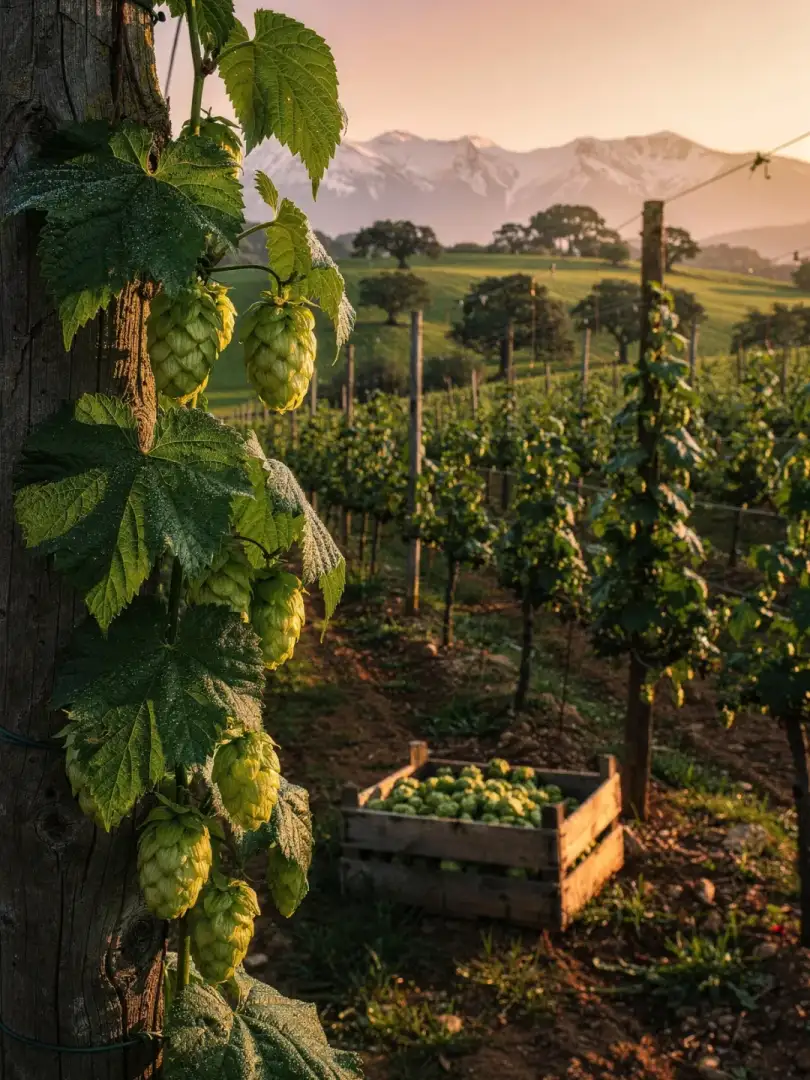
Does hops grow in Catalonia? Hardly any brewery there grows its own — most buy it in. Spain's own hop cultivation is concentrated in the northwest of the country, in the province of León, far from the Mediterranean. The real hop country, as far as the industry is concerned, lies elsewhere — chiefly in Germany, the USA, and the Czech Republic.
For Germany, the BarthHaas report puts the area under cultivation for the 2025 harvest at 18,962 hectares; in the USA, it was 17,057 hectares. Most of the hops used by Catalan brewers come from these two countries. Which specific varieties Estrella Damm or Moritz use, the brands don't disclose.
Hops give beer its bitterness and its aroma. The two can be separated: hop early in the boil and you get mostly bitterness; hop late or cold in the fermenter and you get fragrance. A Spanish lager usually sits at 18 to 25 IBU, the unit for bitterness, making it one of the milder beers in Europe. A German pils starts at 22 IBU and can go up to 40.
Barcelona's craft scene is a different story entirely. There, American and New Zealand varieties are used generously, and the beer smells of grapefruit, mango, or pine resin. Edge Brewing's Hoptimista, an India Pale Ale, is considered in travel guides to be the most awarded beer to come out of Barcelona.
The difference between the two worlds is clear: the big lager is drunk in quantity, without the hops getting in the way. The IPA, on the other hand, is sipped slowly, because the hops take center stage.