Original Gravity and Tax
Schankbier, Vollbier, Starkbier: Beer Categories Explained
In Germany, beer categories are based on original gravity, not on alcohol content. Below 7 percent it's called low-gravity beer; from 7 to under 11 percent, Schankbier; from 16 percent upward, it may be called Starkbier or Bock. Beer tax is also calculated based on original gravity.
What Is Original Gravity, and Why Does It Matter More Than Alcohol?
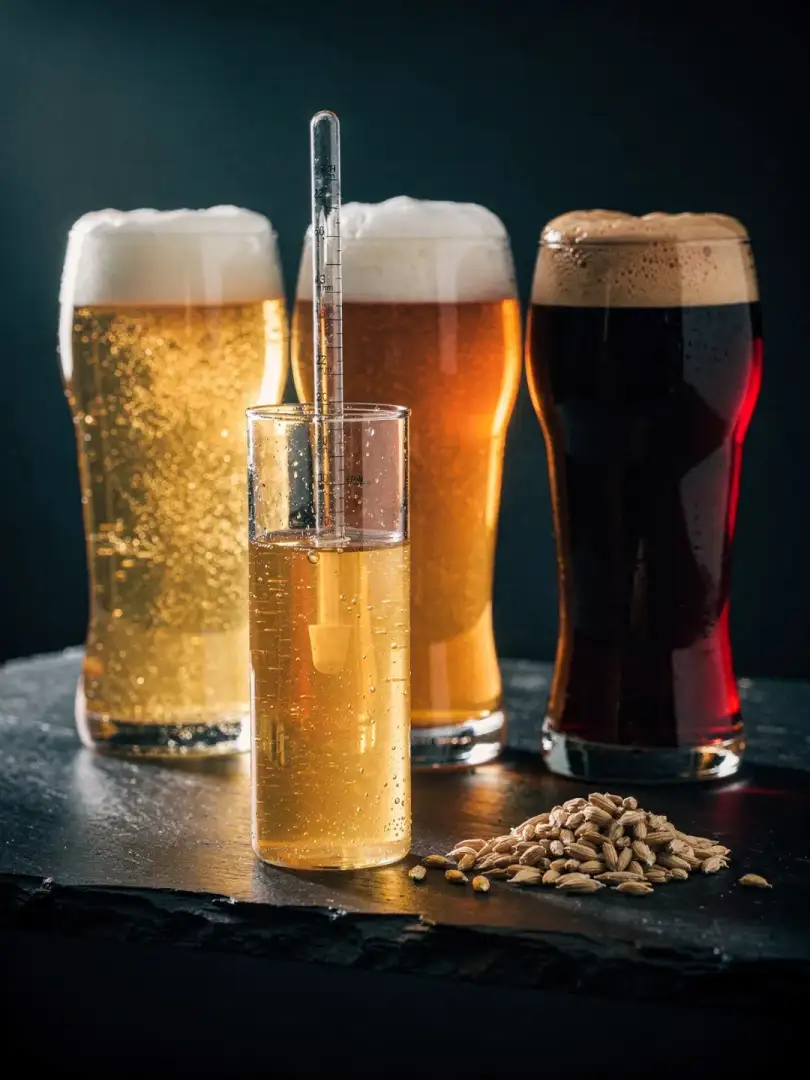
Before yeast gets to work, beer is a sweet liquid called wort. Dissolved within it are malt sugar, protein, minerals and hop compounds. Original gravity indicates how much of this is present, measured in percent or degrees Plato. 12 degrees Plato means 12 grams of dissolved substance per 100 grams of wort. A typical Pils or Helles sits around 11 to 12 percent.
Anyone reading the original gravity on a label is thus learning something about the strength of the recipe, not about its effect. A non-alcoholic beer can have an original gravity similar to a full-strength beer and still contain hardly any alcohol, because fermentation was stopped early or the alcohol was removed afterward. Conversely, a strong beer with a lot of residual sweetness can taste less powerful than its number would suggest.
Why doesn't the law simply measure alcohol? Because original gravity describes the raw material from which everything is made. How much alcohol results from it depends on how far the yeast ferments the sugar. A highly fermented beer will end up stronger and drier at the same original gravity, while a lightly fermented one stays sweeter and fuller-bodied. As a rough rule of thumb, a full beer with 12 percent original gravity usually lands around 5 percent alcohol.
What beer categories does the Beer Ordinance recognize?
§ 3 of the German Beer Ordinance (Bierverordnung) divides beer into tiers. If the original gravity is below 7 percent, it must be labeled "beer with low original gravity." From 7 up to under 11 percent, it's Schankbier, a category for lighter beers. From 16 percent upward, designations like Starkbier (strong beer) or Bockbier are permitted, but not below that threshold. So a beer with 15 percent original gravity may not call itself a Bock, no matter how robust it tastes.
Two terms come up often that aren't actually found in the Ordinance. Vollbier, covering the broad range from 11 up to under 16 percent, comes from the old beer tax law and remains in common use today. Nearly all Pils, Helles, Weissbier and Kölsch styles are Vollbier. Einfachbier, on the other hand, is an outdated tax class and no longer a category today. The Doppelbock, with at least 18 percent original gravity, is likewise a matter of tradition and stylistic norm, not a distinct category under the Beer Ordinance.
How is beer taxed in Germany?
Since January 1, 1993, tax law has been separated from food law, a consequence of harmonization within the EU. Beer tax is based on degrees Plato. The standard rate is €0.787 per hectoliter per degree Plato. For a beer with 12 degrees Plato, that works out to roughly €9.44 per hectoliter, or just under five cents for a half-liter. A Bockbier is taxed more than a Schankbier, because it contains more malt.
Small breweries pay less. A tiered scale reduces the rate depending on annual output: breweries producing up to 5,000 hectoliters pay 56 percent of the standard rate, up to 10,000 hectoliters 67 percent, up to 20,000 hectoliters 78 percent, and up to 40,000 hectoliters 84 percent. The tax is collected by customs authorities, not the tax office. It becomes due when the beer leaves the brewery.
Home brewing: how much beer can you brew tax-free?
Anyone brewing at home may, under § 41 of the Beer Tax Ordinance, produce up to 2 hectoliters, or 200 liters, tax-free per calendar year. The condition: the beer is brewed in one's own household, consumed only by the brewer, and not sold. Sharing it with guests in the household also counts as personal consumption, but selling it at a flea market does not.
Tax-free doesn't mean exempt from notification. Before the first brew, hobby brewers must notify the responsible main customs office of the start and location of production and state how much beer they expect to produce that year. Anyone exceeding the 200-liter limit must file a tax return on an official form. Beer from non-commercial community breweries is treated as if brewed in the home brewer's own household. Under food law, incidentally, home brewers are exempt from the ingredient rules.