Origin with a seal
Protected beers: Kölsch, Münchener Bier and PGI status
Around twenty beer names are protected across the EU, including Kölsch, Münchener Bier, Bayerisches Bier, Oktoberfestbier and České pivo. All carry a PGI, a Protected Geographical Indication. There isn't a single PDO for beer. Düsseldorfer Alt or Berliner Weisse aren't listed in the register.
What does PGI mean for beer?
The EU recognizes two origin labels for foodstuffs. PDO, the Protected Designation of Origin, requires that every step take place within a defined region. PGI, the Protected Geographical Indication, is looser: at least one production step must occur in the region, and the product must have a genuine link to the place. For beer, in practice, it's enough that it's brewed there. Malt and hops may come from elsewhere.
In the EU's eAmbrosia register, beer entries are exclusively PGIs. The first came from England in 1996: Kentish ale and Kentish strong ale, along with Rutland Bitter. In 1998 came a group of German city and regional names, including Reuther, Hofer, Kulmbacher, Bremer, Münchener, Dortmunder and Mainfranken Bier. Anyone brewing outside these regions may not use these names, not even with additions like "in the style of."
A PGI, however, says little about ingredients. What a protected beer may contain is set out in its specification, the description filed with the application. German beers are in any case subject to the Beer Act (Biergesetz), and Kölsch additionally to the Convention.
Kölsch: Convention and origin protection
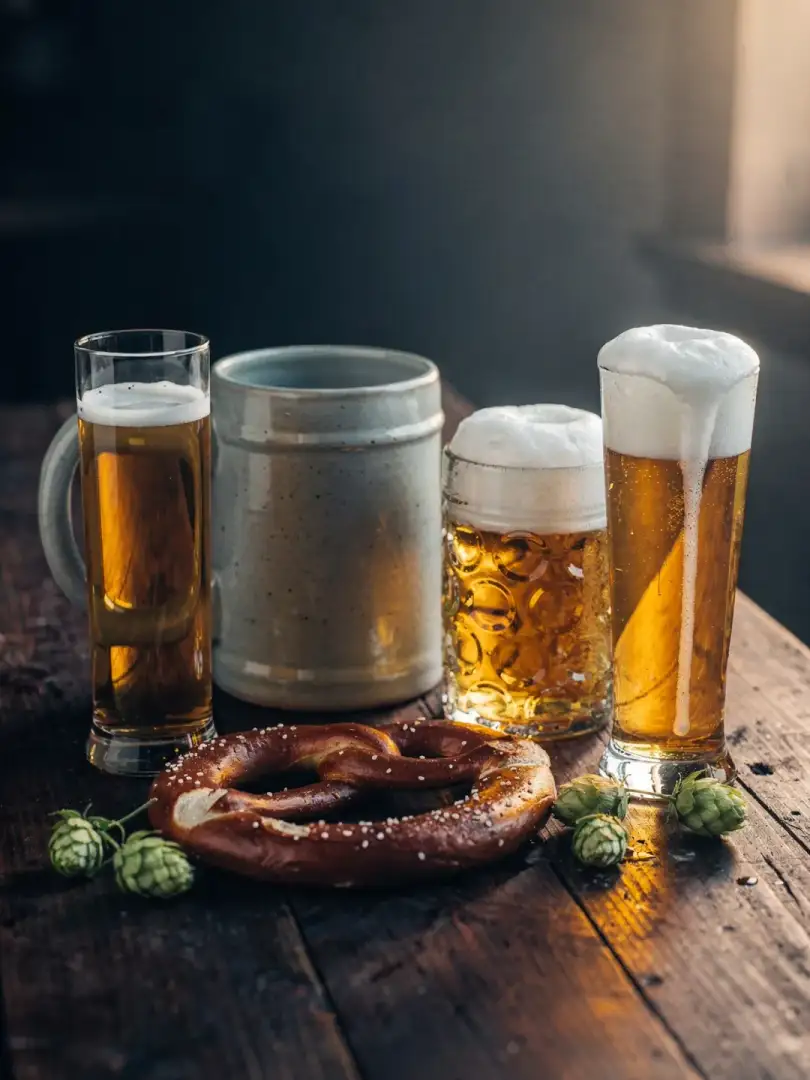
Kölsch has two layers of protection, and they're often confused. On March 6, 1986, 24 breweries signed the Kölsch Convention, a private-law agreement within the Cologne Brewers' Association. It describes Kölsch as top-fermented, pale, bright, highly attenuated, hop-forward, a Vollbier brewed under the Reinheitsgebot, and served in the Stange, a slim, cylindrical glass. Highly attenuated means: the yeast has consumed nearly all the sugar, giving the beer a dry character.
Kölsch has only been protected EU-wide since the regulation of November 25, 1997, as a PGI. It may be brewed in Cologne and by breweries in the surrounding area that were already producing Kölsch before the Convention. The neighboring Altbier from Düsseldorf has neither EU protection nor a comparable convention. It's also top-fermented, but darker, maltier and more bitter. An Alt may therefore be brewed anywhere, a Kölsch may not.
In the glass, malt is what mainly sets the two apart. Both ferment top-fermented, meaning with yeast that works at warmer temperatures, and both are then cold-conditioned. Kölsch is made from pale malt and tastes delicate, lightly fruity and dry. Alt uses darker malts and more hops, glowing copper-brown with a more bitter finish. Origin protection separates them further, beyond just taste.
Bayerisches Bier, Münchener Bier and Oktoberfestbier
"Münchener Bier" has been protected since July 18, 1998, and "Bayerisches Bier" since July 5, 2001. Both are origin names, not styles: a Bayerisches Bier can be a Helles, Weissbier, Dunkel or Bock. What matters is that it's brewed in Bavaria. The name says nothing about style, but something about ingredients: Bavaria's strict no-sugar rule applies there regardless.
Oktoberfestbier was applied for in 2012 and only registered in 2022. It may only be brewed by breweries within the city limits of Munich, effectively the six members of the Club of Munich Breweries: Augustiner, Hacker-Pschorr, Hofbräu, Löwenbräu, Paulaner and Spaten. In addition, "Oktoberfest-Bier" is a collective trademark of the club. Today it's served as a pale, golden festival beer. The amber-colored Märzen often associated with the Wiesn was brought to the festival by Spaten in 1872 as "Ur-Märzen."
Czechia, England, Flanders: protected beers elsewhere
Czechia holds the most protected beer names after Germany. Since 2003, Budějovické pivo, Budějovický měšťanský var and Českobudějovické pivo have been registered, followed in 2008 by Chodské pivo and České pivo, and later by Znojemské, Brněnské, Březnický ležák and Černá Hora. Lithuania added Kaimiškas Jovarų alus, a farmhouse beer, in 2019.
Flanders is the newest addition. Vlaams roodbruin bier, known in English as Flanders Red Ale, was registered as a PGI on October 1, 2026. This is a reddish-brown, sour beer aged in wooden barrels. It's worth checking the flip side too: Düsseldorfer Alt, Berliner Weisse, Einbecker Bier, Leipziger Gose and Bamberger Rauchbier are not listed in the EU register. Calling them EU-protected would be incorrect, even though individual brands may be protected in other ways.