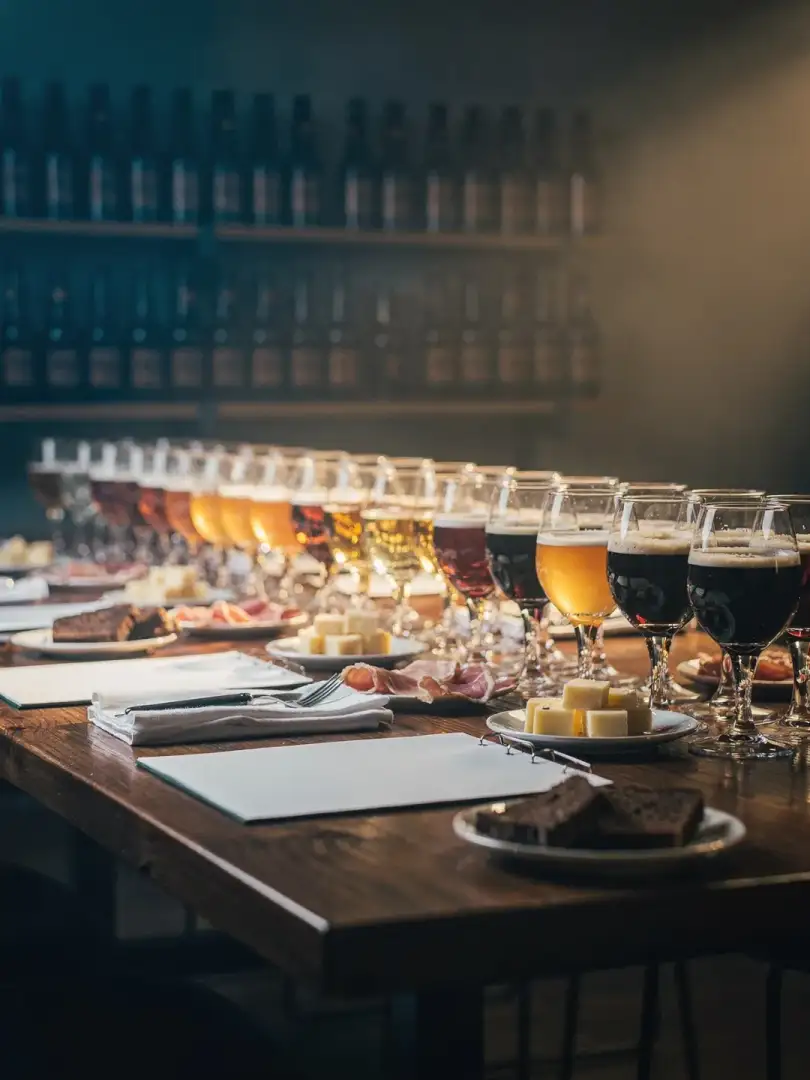
Experts of Taste
Beer Sommelier: Training and Career
You become a beer sommelier through continuing education, not through a state-recognized apprenticeship. In German-speaking countries, the Doemens Academy near Munich has offered its Diplom-Biersommelier course since 2004. In North America, the Cicerone program, founded in 2007, is widespread.
What Does a Beer Sommelier Do?
A beer sommelier acts as a go-between for brewery and guest. They describe beers in a way even beginners can understand, recommend suitable styles, and pair beer with food. They lead tastings, train service staff, and advise restaurateurs on their beer lists. Many work in breweries, beverage retail, or hospitality, while others work as speakers on the side.
They differ clearly from a brewer. Brewer and maltster is a recognized apprenticeship in Germany that teaches the craft of making beer. A beer sommelier doesn't need to be able to brew beer. But they do need to know how malt, hops, yeast, and processes shape flavor—otherwise they can't explain the styles.
In everyday practice, this mostly means translating. A guest asks why their wheat beer smells like banana even though it contains no fruit. Another wants to know whether a Trappist beer is its own style. The beer sommelier then explains that the banana comes from the yeast, and that Trappist is a mark of origin, not a style. Answers like these make beer understandable without being preachy.
Beer Sommelier Training at Doemens and Other Providers
The best-known training program in German-speaking countries is the Diplom-Biersommelier offered by the Doemens Academy in Gräfelfing near Munich. According to Doemens, it has been offered since 2004. To date, Doemens reports that more than 2,000 German-speaking participants have completed the course. Worldwide, it's offered in 17 countries and eight languages, and the network counts over 6,000 beer sommeliers, according to the academy.
The curriculum covers raw materials, brewing technology, beer styles of the world, sensory analysis, beer faults, serving, and food pairing. A large part is hands-on tasting. According to the academy, the course is available in several formats, including a modular version that can partly be completed from home.
There are other providers as well. The Kiesbye Akademie in Obertrum in Austria's Salzburg region offers a beer sommelier training as an online course. The University of Teacher Education Vienna offers an academic program on the subject of beer. In Weihenstephan near Freising, the Technical University of Munich has long trained brewers and brewing engineers—but that's a brewing-technology degree, not sommelier training.
Cicerone: The American Counterpart
In the US, brewer and author Ray Daniels founded the Cicerone Certification Program in 2007. The name comes from the Italian word for guide. The first exam was held online on January 3, 2008.
The program is structured in levels. It starts with Certified Beer Server, an online exam for service staff covering glassware, draft systems, and beer styles. This is followed by Certified Cicerone, which includes a tasting component, then Advanced Cicerone, and finally the highest level, Master Cicerone. The focus leans more heavily toward beer care and dispense than many European courses.
Beer Sommelier and Cicerone overlap considerably but place emphasis differently. Both require knowledge of styles, sensory evaluation, and off-flavors. The Cicerone system tests in clearly separated levels and is explicitly aimed at service staff behind the bar. The Doemens training is designed as a single cohesive course with a final exam and emphasizes advising the guest, for example when choosing beer to pair with food.
World Championship for Beer Sommeliers and the Path into the Profession
Every two years, beer sommeliers from many countries compete at a world championship organized by Doemens. The eighth world championship took place in Munich in September 2025. The tasks range from blind tastings and identifying off-flavors to freely presenting a beer in front of an audience.
Beer sommelier is not a protected title backed by a state exam in Germany. Anyone booking the course should pay attention to its scope, exam, and the provider's reputation. More helpful than any certificate is practice: tasting many styles, comparing notes, and deliberately getting to know off-flavors.