Cool & Slow
Yeast & Fermentation
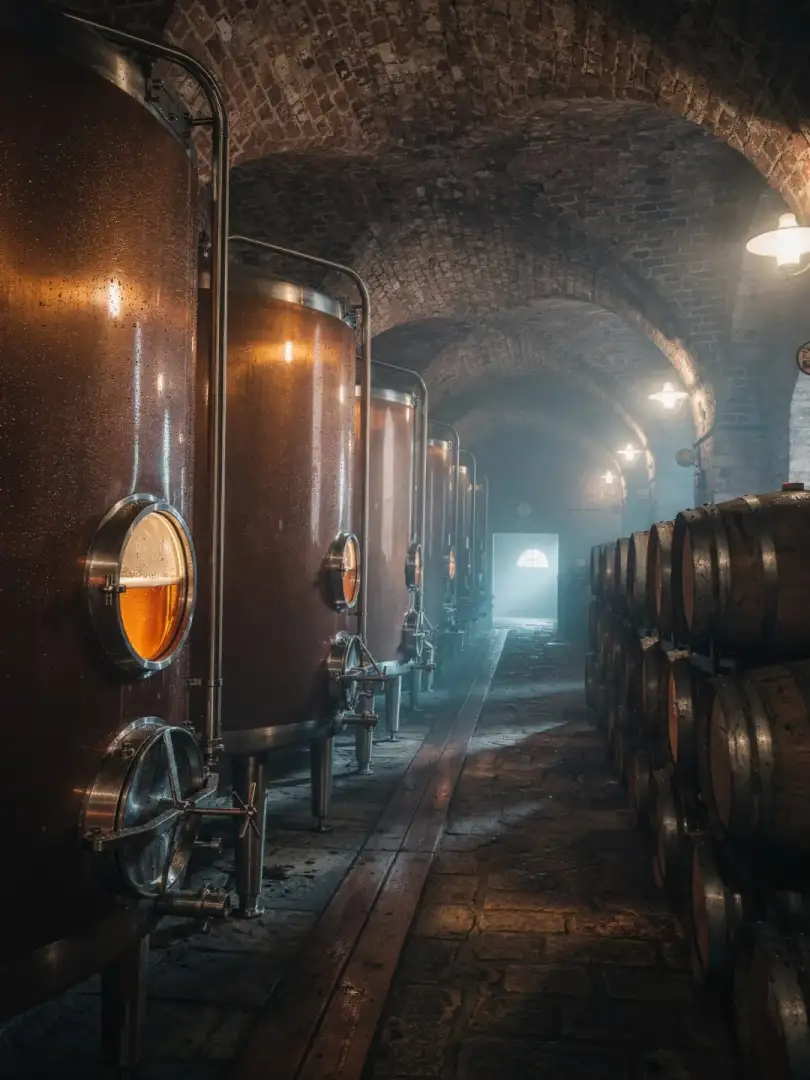
Czech lagers ferment at the bottom. The yeast works at a cool eight to ten degrees Celsius, settling at the bottom of the tank after fermentation and giving the beer a clean, settled character.
The yeast itself, Saccharomyces pastorianus, is a hybrid of two species: the familiar brewer's yeast Saccharomyces cerevisiae and the cold-loving Saccharomyces eubayanus. This cross is what makes fermentation at low temperatures possible.
Primary fermentation is followed by lagering, known in Czech as "ležení." During this stage, the young beer matures cold for several weeks, allowing sulfur notes to fade, carbonation to bind, and the beer to turn clear. A Czech Ležák takes its name from this very process of "lying" in the tank to mature.
Their measure of strength is degrees of original gravity. Original gravity indicates how much sugar the unfermented wort contained. A beer labeled "Ten" (desítka) had roughly ten grams of extract per 100 grams of wort, while a "Twelve" (dvanáctka) has correspondingly more. The alcohol content comes down to what the yeast makes of that sugar: the more it finds in the wort and ferments, the stronger the beer becomes, and whatever's left behind stays as sweetness in the glass.
As an exception, Ostravar brews the dark beer Kelt, a dry stout. Stouts ferment at the top, meaning warmer temperatures and a different yeast strain. In Moravia, this is a rare example of a beer stepping outside the lager tradition. It shows that even a country devoted to bottom-fermented beers still has room for a dark, dry style with roasted character that drinks very differently from a Ležák.