Five Protected Names
Region & History
What is Šljivovica, and who's allowed to use the name? Plum brandy is found all across the Balkans, yet in Croatia and Slovenia several brandies carry their own protected names. Croatia has been part of the EU since 2013, Slovenia since 2004. For Croatia, the EU register lists Hrvatska stara šljivovica, Slavonska šljivovica and Hrvatska loza, while for Slovenia it lists Dolenjski sadjevec and Brinjevec.
Hrvatska stara šljivovica may come from anywhere in Croatia. As proof of its tradition, its specification cites the Zagreb factory Patrija, founded in 1886, which offered a plum brandy under the name "Stara samostanska šljivovica", and it references a trade fair catalogue from 1925. As a modern-day example, the document names Stara Badel šljivovica from the Zagreb house Badel 1862.
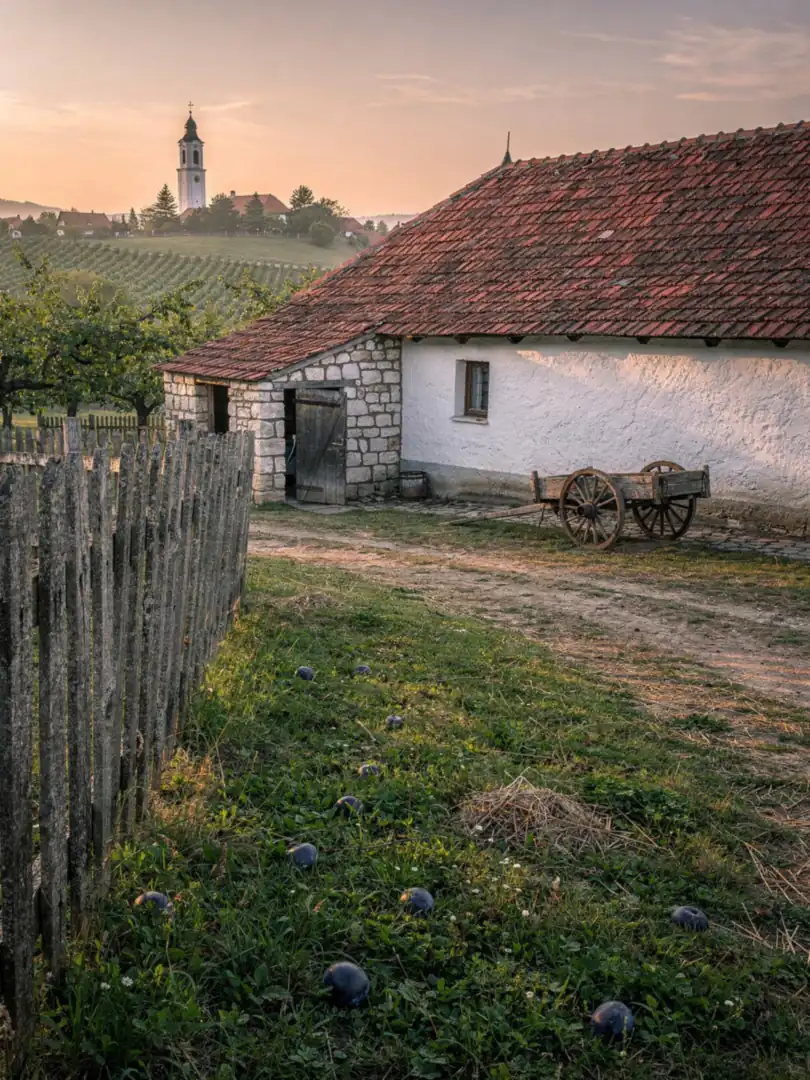
Slavonska šljivovica, by contrast, belongs to Slavonia, the lowland plain in the east of the country between the Sava and Drava rivers. Plum trees have lined the farmyards there for generations, and the specification speaks of a distilling tradition going back more than a century. It is distilled once and matures in barrels made of Slavonian oak.
Slovenia takes a different approach. Dolenjski sadjevec comes from Dolenjska, the Lower Carniola region in the southeast, and is made from mixed fruit. Brinjevec is distilled from fermented juniper berries. The best known are Kraški brinjevec, from the Karst plateau and the Brkini hills, and Pleterski brinjevec, produced at the Pleterje Charterhouse in Dolenjska. According to Slovenian public radio, Kraški brinjevec has been distilled by farmers for centuries and was first mentioned around 200 years ago.
Two further protected names aren't fruit brandies at all: Hrvatska travarica is a herbal spirit, while Zadarski maraschino is a liqueur from Zadar. How they differ from the brandies is explained in the section on style.