Marshland and Dikes
Region & History
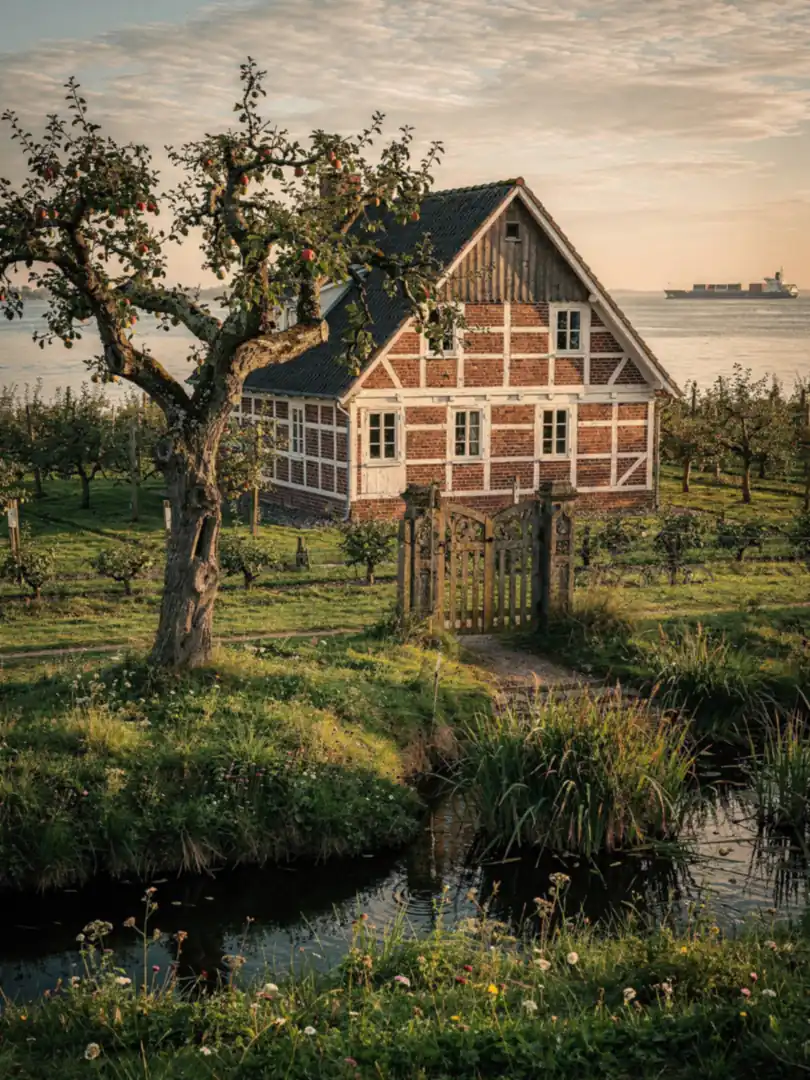
The Altes Land between Hamburg, Stade and Buxtehude was once marshland. In the 12th century, the Archbishop of Bremen brought in Dutch settlers, who diked the land and drained it with a network of ditches. From this marsh grew what is now the largest continuous fruit-growing region in Northern Europe. The Elbe runs right past the doorstep, and Hamburg's harbor lies only a few kilometers away.
Fruit has grown here for over 700 years, and today around 10,500 hectares are given over to orchards, mostly apple trees supplying dessert apples for the trade. Because of this, the Altes Land never became a distilling region like the Ortenau or the Wachau, and distilleries remain few and far between in this far-north corner.
Anyone wanting to produce apple brandy in Germany needs a license, since private distilling is prohibited. An Abfindungsbrennerei (small-scale licensed distillery) is capped at 300 liters of pure alcohol per year; the operation needs at least 3 hectares of land, though 1.5 hectares suffice for intensive fruit cultivation. The old spirits monopoly for fruit distilleries expired at the end of 2017; since then, the Alcohol Tax Act applies, with a license tied to the individual producer.
Among the region's distillers is the Nordik Edelbrennerei in Jork, which states that it works with fruit from the Altes Land. In Hamburg, the Edelhof1514 manufactory operates out of a listed half-timbered house dating to 1514, and has remained in family hands for four generations.
There is no dedicated protected designation of origin for apple brandy from the Altes Land in the EU register of protected spirits. What's distilled here therefore carries the general label Apfelbrand (apple brandy) and must meet the standards for fruit brandy: at least 37.5% ABV, no added neutral alcohol, no flavorings, no coloring.