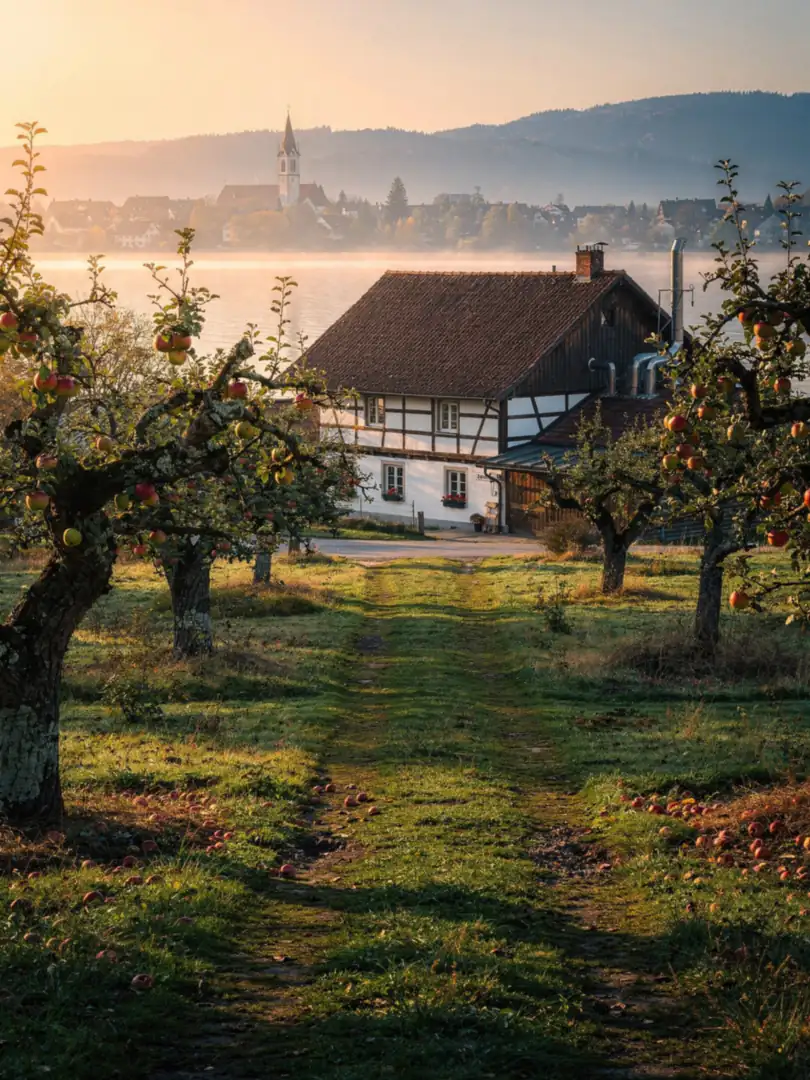
Fruit by the Lake
Region & History
Anyone driving along the German shore of Lake Constance in autumn will see apple trees right up to the roadside. According to the state of Baden-Württemberg, around 1,200 fruit farmers cultivate roughly 7,000 hectares in the Bodensee fruit-growing region, and most of it is given over to apples. Pears, cherries, plums, and berries also grow here. Whatever the trade doesn't take often ends up at the distillery.
Distilling has been practiced in southern Germany since the Middle Ages, first in monasteries and apothecaries, where alcohol was understood as medicine and called "aqua vitae." Later, farmers took over the craft. Windfall fruit and surpluses could be preserved this way, and the mild lake climate ensured there was always plenty of it along the shore.
Anyone wishing to distill fruit in Germany today needs a license, since private, unauthorized distilling is forbidden. The common route is the so-called Abfindungsbrennerei, or flat-rate distillery: an agricultural operation with at least three hectares of land, or one and a half hectares of orchard or vineyard, may produce up to 300 liters of pure alcohol per year. The spirits monopoly, to which fruit distillers once had to deliver their alcohol, ended for them on December 31, 2017. Since January 1, 2018, the Alcohol Tax Act has applied instead.
Just how densely distilling runs through the region is shown by the Lindau district. A 2021 newspaper report counted more than 400 distilleries there, each with a 300-liter quota, adding up to around 100,000 liters of alcohol a year. The raw materials range from cider apples to quinces, mirabelles, and even medlars.
One name in particular kept the distillers busy. In 2019, Germany, Austria, and Switzerland jointly applied to register "Bodensee Obstler" and "Bodensee Birnenbrand" as protected geographical indications. Both applications have since been withdrawn from the EU register. An Obstler from Lake Constance is therefore a spirit from the region, but not an EU-protected product.
Among the notable houses on the lake are Weingut Steinhauser in Kressbronn, which says it has been producing wine and spirits since 1828, and Edelbrände Senft, described by the company as a family distillery with over 35 years of experience.