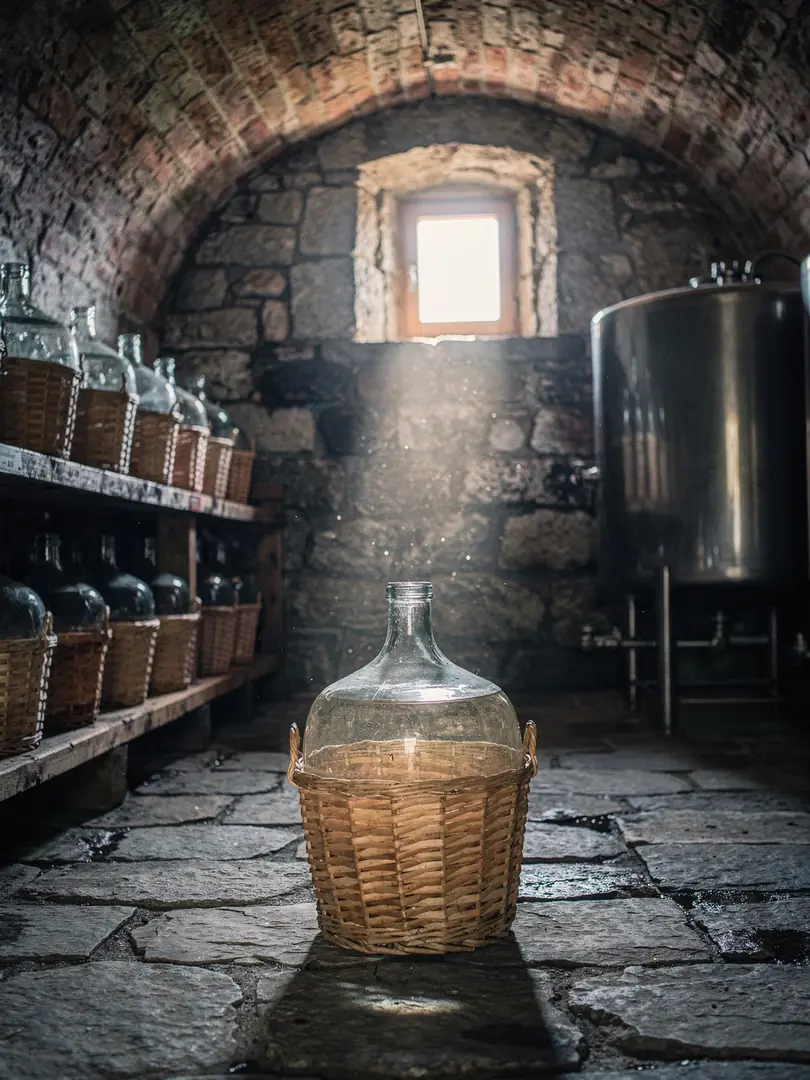
Rest in the Glass Demijohn
Maturation & Storage
Fresh from the still, a fruit spirit often tastes sharp and restless, its aromas not yet in harmony. That's why it's left to rest. Williams Christ, Obstler, and apple brandy from Lake Constance are usually aged in large glass demijohns, stainless steel tanks, or, in earlier times, stoneware vessels, kept in a dark, cool place. These containers impart nothing to the spirit, so the fruit stays front and center and the spirit remains perfectly clear.
There's a reason for the darkness. Hydrogen cyanide, which in stone fruit comes from the pits, can turn into ethyl carbamate under light exposure, a substance that has no place in the spirit. With apples and pears the issue is smaller, but even here it holds true that a spirit kept out of sunlight stays fresher longer.
How long a spirit must rest isn't prescribed by law for fruit brandy. There are no EU age classifications as there are for brandy or Cognac. Terms like "old" or "Reserve" on the label are simply the producer's own claims. Even so, one rule applies: an age statement may only be given if it reflects the youngest component in the spirit.
Those who want to use wood are free to do so. Fruit spirits may be aged in oak, ash, or other woods. They then take on a golden to amber color, and the spirit gains notes of vanilla and spice that compete with the fresh fruit aroma. Coloring with additives is forbidden; only caramel coloring for color adjustment is permitted, and only after at least one year in wood.
For most fruit spirits from the lake, classic storage remains the norm. The resting period lasts months, sometimes one to two years. During this time the rough edges soften, the fruit aroma becomes more integrated, and the scent of mash and raw alcohol recedes. A short, careful rest changes the spirit far more than one might expect.