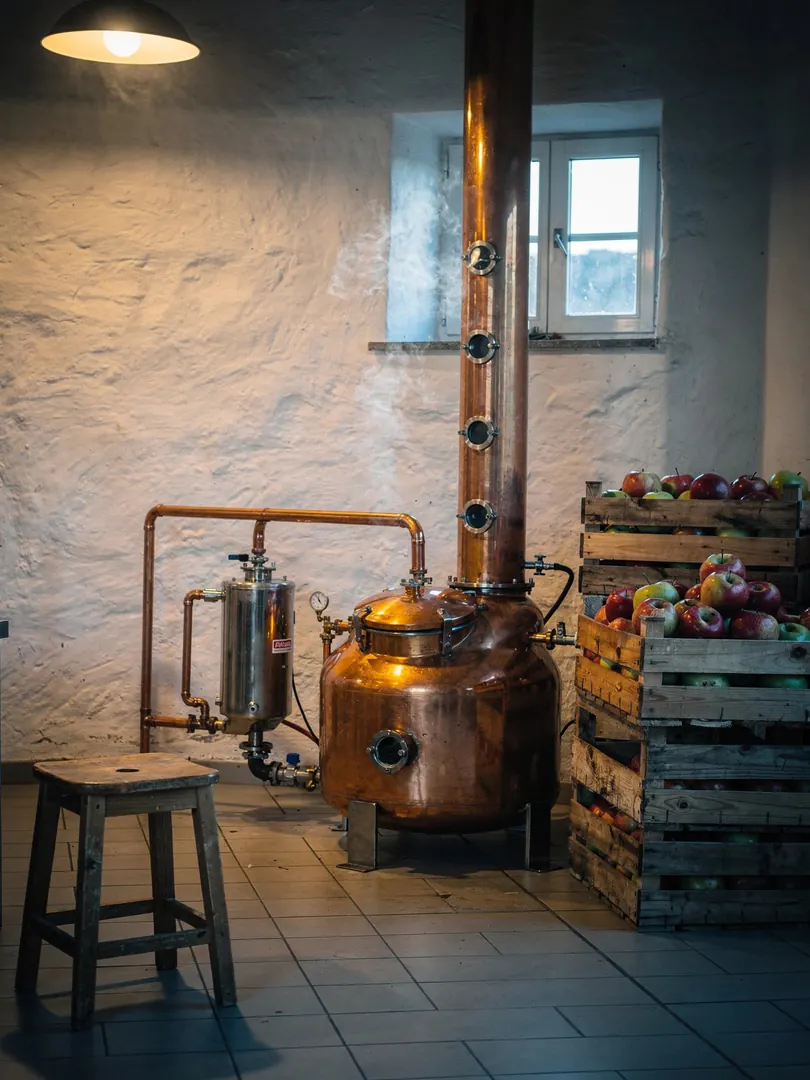
Pot and Column
Distilling
During distilling, the distiller heats the mash in a copper pot still. Alcohol and aromatic compounds evaporate before water does, rise up, condense again in the cooler, and drip out as distillate. This is how the cloudy mash becomes a clear, aromatic spirit. Distilling without a license is illegal in Germany.
Distilleries in the Lindau district and around Lake Constance often use a pot still fitted with a rectifying column, which enriches the distillate in a single pass. The classic method, by contrast, is double distillation, producing first a low wine and then a fine spirit. For fruit spirits, EU rules require only that each distillation stay below 86 percent alcohol, so the fruit's aroma is preserved.
The distiller separates the spirit into three parts. The heads contain volatile compounds with a solvent-like smell and are discarded. The hearts form the heart of the run, the part that later ends up in the glass. The tails bring heavy, fusel-like notes and are also cut away. The skill lies in recognizing the boundaries between these parts.
A common misconception holds that discarding the heads frees a fruit spirit from methanol. That's not true. Methanol is distributed throughout the entire run, and removing the heads only reduces it partially. This is exactly why legal limits exist, and legally produced spirits comply with them. Methanol becomes dangerous only in adulterated, illicitly made alcohol.
Distilling in Germany is strictly regulated. A flat-rate distillery (Abfindungsbrennerei) doesn't measure the alcohol produced but calculates it using official official yield rates. There's also the category of raw-material owners: anyone with their own fruit but no equipment can have it distilled at a flat-rate distillery and is allowed to produce up to 50 liters of pure alcohol per year. Distilling with one's own unlicensed equipment remains illegal.
Finally, the spirit is diluted with softened water down to drinking strength, usually around 40 percent ABV. EU law requires a minimum of 37.5 percent.