Cherry Country Pretzfeld
Region & History
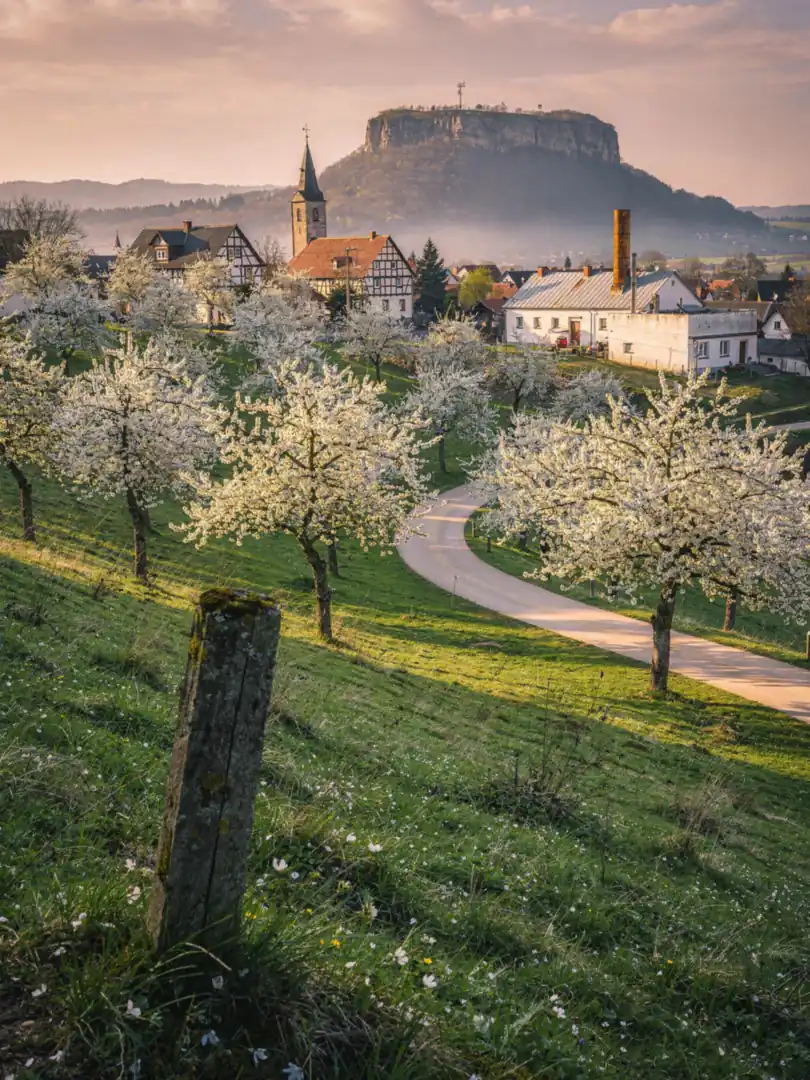
Anyone driving through the Trubachtal in April sees hillsides that look as if it had snowed overnight. Between Pretzfeld and the Walberla in the Forchheim district, the region counts around 200,000 cherry trees spread across roughly 2,500 hectares. This is considered Germany's largest contiguous sweet cherry-growing area, and in tourism circles it's even described as the largest in all of Western Europe.
Not all of this fruit ends up at market—some goes straight to the distillery. Franconian Switzerland is home to a striking number of small family-run operations that distill alongside farming, often following recipes passed down through generations. Here, distilling is a side income for the farm, not an industry.
Distilling in Germany is strictly regulated by law. Until December 31, 2017, everything hinged on the spirits monopoly, and the distilling right belonged to the farm itself. Since January 1, 2018, the Alcohol Tax Act has applied, and the permit belongs to a person instead. A so-called Abfindungsbrennerei (flat-rate distillery) may produce no more than 300 liters of pure alcohol per year and requires a farm with at least three hectares of land—or just 1.5 hectares in the case of intensive fruit or wine growing. Lawmakers justify the tax reduction as a way to preserve traditional orchard meadows.
The region's name is protected. Since 1989, Fränkisches Kirschwasser has carried a protected geographical indication from the EU, as have Fränkisches Zwetschgenwasser and Fränkischer Obstler. For Kirschwasser, the cherries must come from Franconia, and both fermentation and distillation must take place there too. The spirit is bottled at a minimum of 40 percent alcohol, with no added sugar, coloring, or wood chips.
Right in the middle of the growing region, for example, works the Edelbrennerei of Johannes Haas in Pretzfeld. Incidentally, Schwarzwälder Kirschwasser is its own separate product with its own designation: both are cherry fruit brandies, but each may only carry the name of its own place of origin.