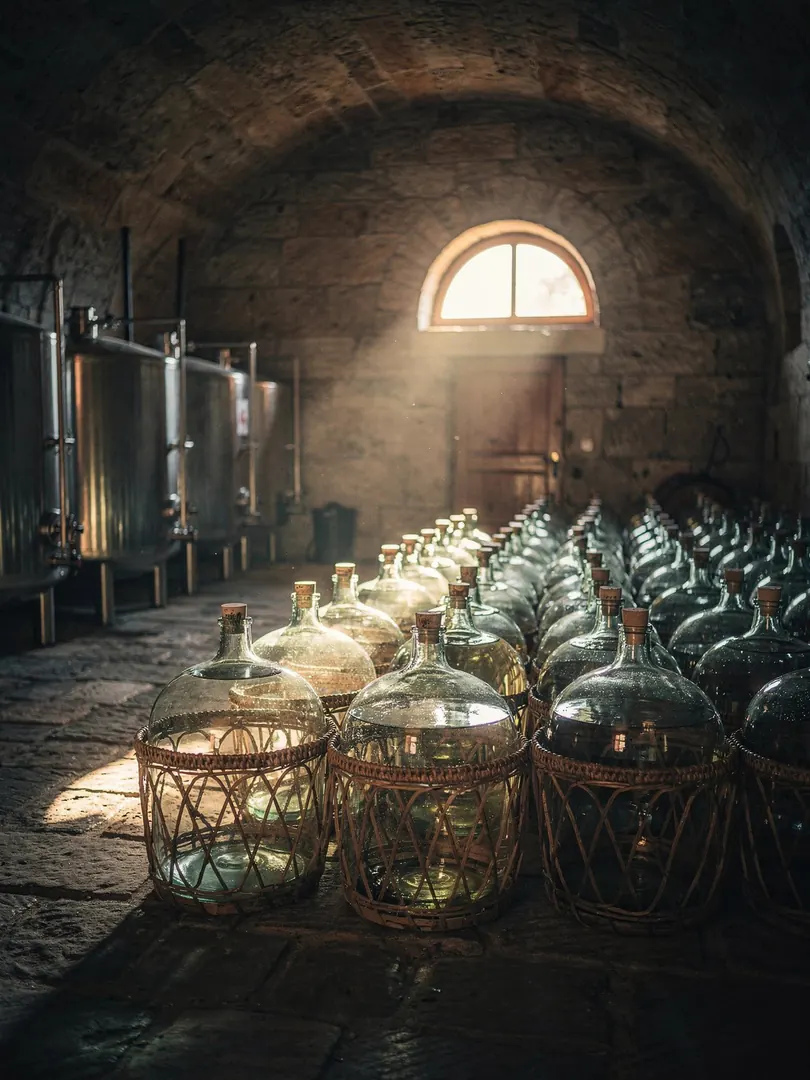
Resting in Glass Demijohns
Maturation & Storage
In a distillery's cellar, Kirschwasser typically rests in glass demijohns or stainless steel tanks rather than barrels—stoneware vessels were once common too. These containers give nothing to the spirit. The fruit aroma is meant to stay exactly as it is, and the spirit is meant to remain clear.
That's why Kirschwasser is colorless. Fruit brandies may not be colored within the EU, and caramel coloring is only permitted if the spirit has had at least one year of contact with wood. For Fränkisches Kirschwasser specifically, oak chips and wood-lined containers are explicitly excluded, as are added sugar and coloring.
There's no legal minimum aging period for fruit brandy. If a producer states an age anyway, the claim may only refer to the youngest component, and the aging must have taken place under tax supervision. Terms like old or Reserve are simply marketing language from the producer, not protected classifications.
So why let the spirit rest at all? Freshly distilled, Kirschwasser often tastes rough and unsettled. Over time in a neutral vessel, the aroma rounds out, the notes come together, and the almond-like pit character recedes. How long a distiller waits is their own decision, based on the vintage and desired style. Even a Fränkisches Kirschwasser from the villages around Pretzfeld has no prescribed resting period—only the time the distiller chooses to give it. The law only requires that the spirit stays clean, with nothing added that would mask the fruit.
The contrast with whisky or Cognac is stark. There, the cask shapes the character; here, the cherry is meant to take center stage. Anyone familiar with amber-hued spirits from oak barrels will see a clear Kirschwasser as an entirely different craft.