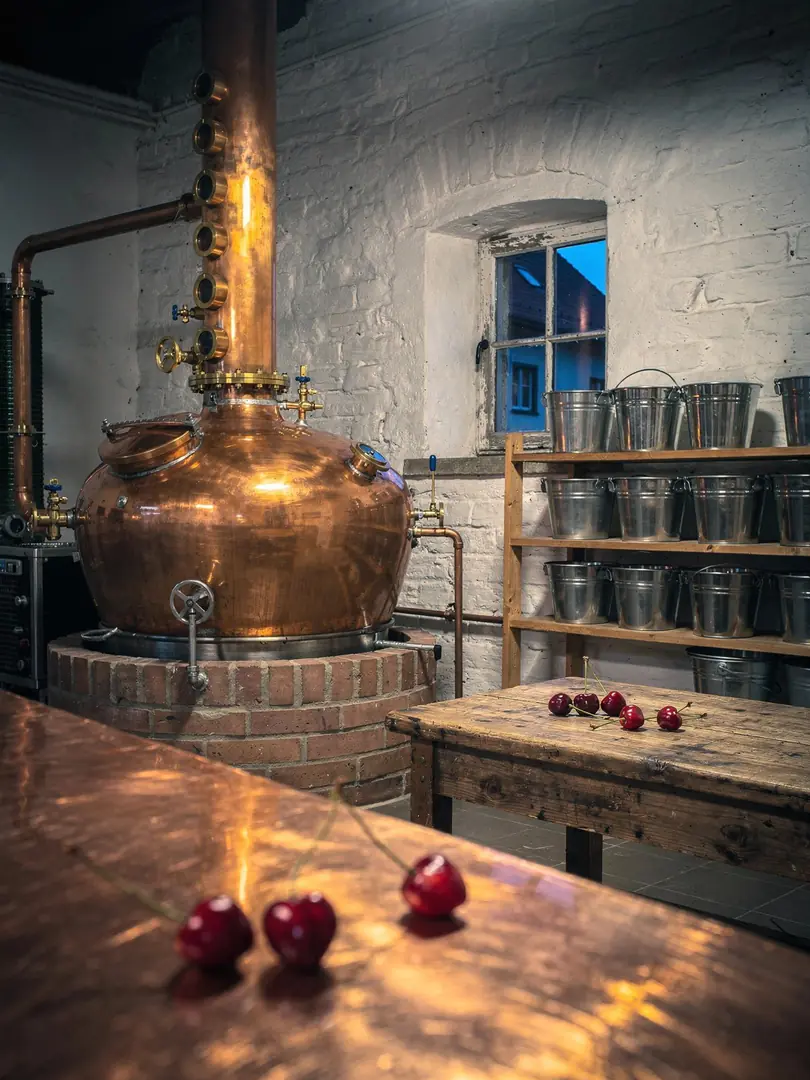
Pot and Column
Distillation
In the copper pot still, the fermented cherry mash boils, and alcohol rises before water does. The vapor is cooled, condenses back into liquid, and runs off as a clear distillate. This is how a mash of just a few percent alcohol becomes a spirit with far higher strength.
Many fruit distilleries fit a rectifying column atop the pot, concentrating the alcohol in a single pass. The classic method is double distillation: first comes the Raubrand, a cloudy, weak first distillate, followed by the Feinbrand from a second pass. The distillate must stay below 86 percent alcohol to preserve the fruit's aroma.
More important than the equipment is the separation of fractions. The heads (Vorlauf) contain light compounds that smell like solvent and are cut away. The heart (Mittellauf) is the drinkable portion. The tails (Nachlauf) bring heavy, fusel-like notes and are also cut away, often redistilled. A common misconception is that discarding the heads removes methanol from the spirit entirely. In fact, methanol spreads across the whole run, and the cuts only partially reduce it.
Anyone wanting to distill in Germany needs a permit. In an Abfindungsbrennerei, alcohol isn't measured directly but calculated from the raw material quantity using an official yield rate. Anyone with their own cherries from a backyard tree but no still can have them distilled by a licensed Abfindungsbrennerei as a so-called Stoffbesitzer (raw material owner). The law allows a maximum of 50 liters of pure alcohol per year, one person per household. Distilling at home without a license remains illegal, even for personal use.
Finally, the distillate is cut with water down to drinking strength. For Fränkisches Kirschwasser, that means a minimum of 40 percent alcohol, whether in the Forchheim district or anywhere else in Franconia.