A Pear with a Seal
Region & History
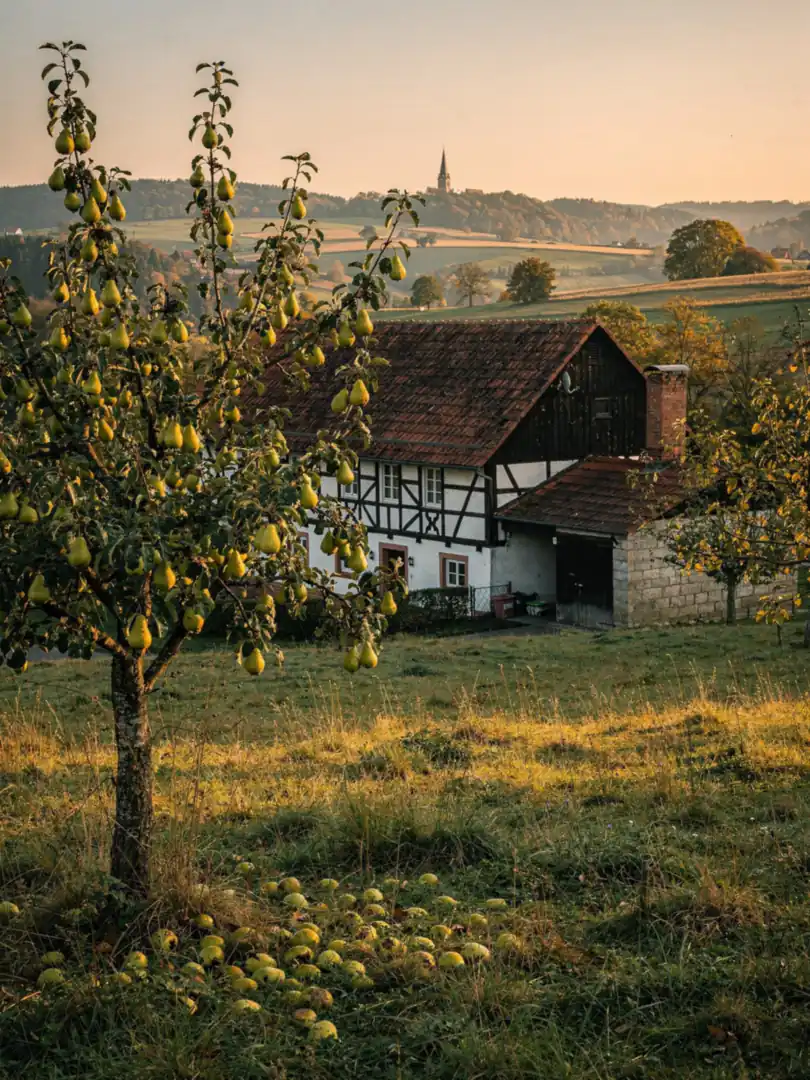
Between the Kocher, Jagst, and Tauber rivers, standard pear trees stretch across the slopes of the Hohenlohe Plain, white with blossoms in spring and yellow with windfall fruit in the grass come autumn. Farmers distill these small, tart fruits into pear brandy, commonly called Birnenwasser in everyday speech. This fruit brandy belongs to the farmstead just as much as the orchard meadow behind it.
The name has been protected EU-wide since 2022. Protection for Hohenloher Birnenbrand and Hohenloher Birnenwasser was first applied for back in 2019, and the Commission registered both names under Regulation (EU) 2022/888 of 31 May 2022. According to the state of Baden-Württemberg, the impetus came from a food summit held in Schwäbisch Hall in 2015, where pear brandies from the region were served alongside local cheeses.
What the name requires is both modest and strict. The pears must be grown in Hohenlohe, and the distilling must also take place there. Only varieties native to the area for centuries, grown on vigorous rootstock, meaning standard trees, may be used. Table pears such as Williams Christ are excluded. Once bottled, the brandy must have a minimum strength of 38% ABV.
Who may distill spirits in Germany is governed by the Alcohol Tax Act. Distilling at home without a permit is forbidden, even for personal use. What's permitted is distilling under an Abfindung license, typically held by agricultural operations that produce no more than 300 liters of pure alcohol per year and pay a flat tax on it. Anyone who has pears from their own tree but no equipment can have them distilled there instead. Such a person is called a Stoffbesitzer and may obtain up to 50 liters of pure alcohol per year.
The brandy monopoly for fruit and Abfindung distilleries ended on 31 December 2017. Since then, the license belongs to a person, not to the farm itself. Lawmakers justify the reduced tax rate by pointing to the preservation of orchard meadows, and it's precisely these meadows that define Hohenlohe.