Standard Trees and Perry Pears
Fruit & Raw Material
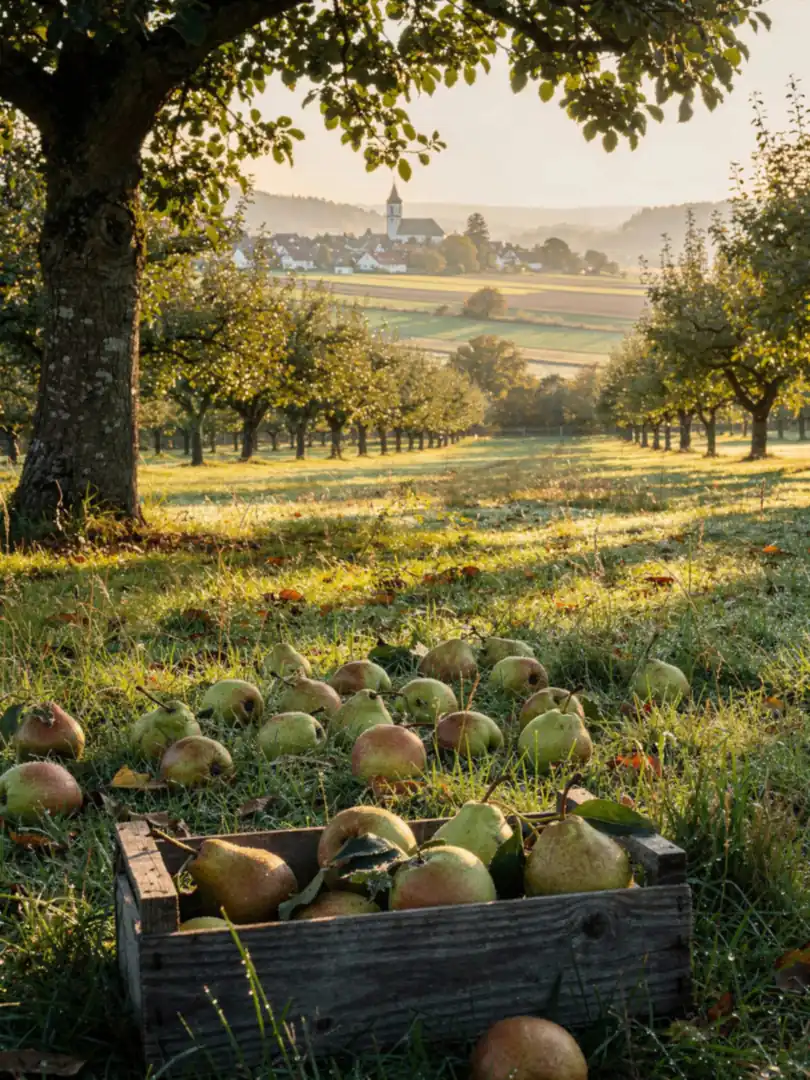
In September, it's the first thing you notice: the sweetish smell beneath the trees, where pears lie in the grass and wasps are hard at work. Perry pears aren't meant for biting into. They're small, hard, and rich in tannins, which suits the distiller just fine.
The name requires that only regionally typical varieties be used, grown on vigorous rootstock and native to Hohenlohe for centuries. That means standard trees. Such trees grow for decades, bear fruit late, and leave the meadow or pasture beneath them open. A plantation tree, by contrast, stays low and bears fruit early, but it isn't what's called for here.
Sweet table pears like Williams Christ are excluded. These go into a different category, Williams-Brand, and only a brandy made exclusively from this variety may carry that name. Hohenloher Birnenbrand relies on the tartness of old perry pears. Even among these, there's great variety, from small, hard fruits to juicy ones with a mild tang. What matters most for the brandy is how much aroma and sugar the fruit holds.
Harvesting happens once the fruit is ripe and either falls on its own or can be shaken from the branch. Pears soften quickly after harvest. Leave them too long and you risk rot, which later shows up in the taste of the brandy. That's why speed matters most at harvest time.
The survival of these trees has much to do with distilling. A standard pear tree barely pays off as table fruit, but as raw material for brandy and perry, it does. In the Tauber Valley near Weikersheim and Creglingen too, fruit trees shape the hillsides.