Plums Along the Main
Fruit & Raw Material
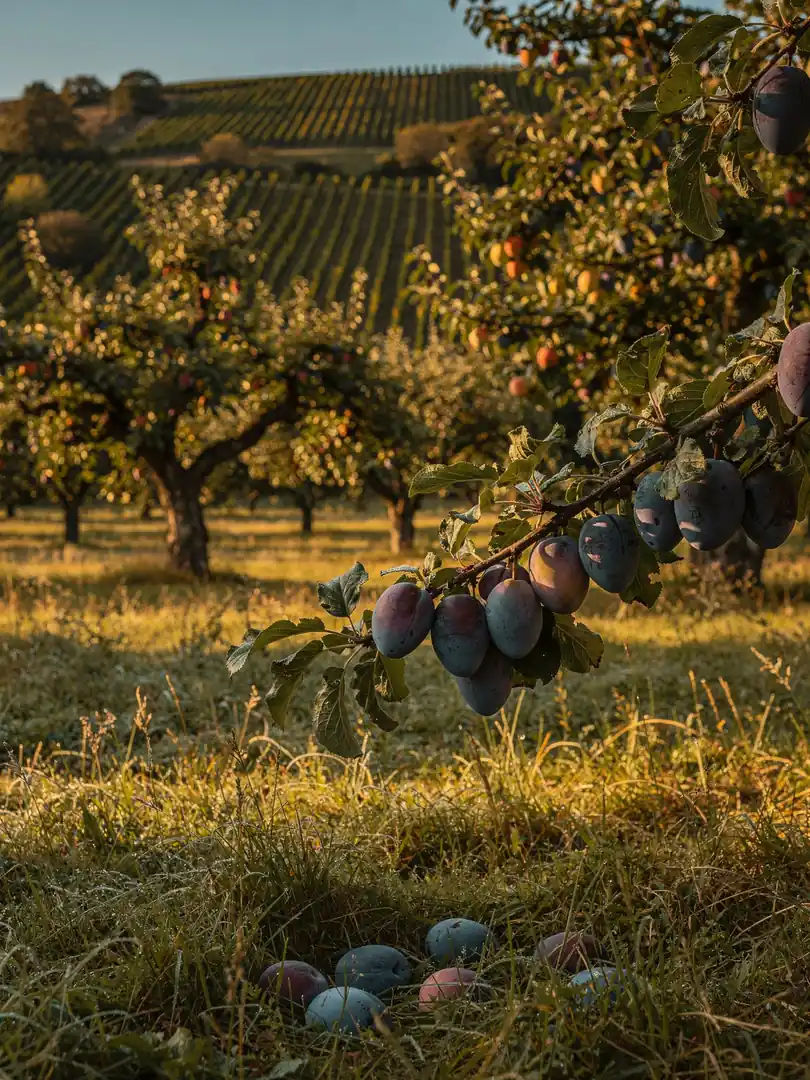
In late summer, before the grape harvest even begins, the plums hang ripe on the branches. These elongated, blue-violet fruits have a stone that separates easily from the flesh, which is how you tell them apart from the round plum.
For the distiller, it's not the prettiest fruit that counts, but the ripest, sweetest one. Varieties grown on standard and half-standard trees in Franconia include the Bühler Frühzwetschge, Toptaste, and the classic Hauszwetschge. As with any stone fruit, the rule holds: the riper the fruit, the more sugar is available for the yeast, and the more aroma the eventual spirit will carry.
Many of these trees stand in traditional orchard meadows. Zwetschgenwasser helps preserve them, since the spirit makes use of surplus fruit, windfalls, and fruit that can't be sold commercially. A blemished or soft fruit is no flaw for the mash, as long as it stays clean and sound.
Obstler comes from the apple and pear trees growing on the same slopes. Different varieties are allowed to mingle: apples bring freshness and acidity, pears bring sweetness and aroma. Under EU law, a spirit may only be called Obstler if at least 85 percent of the mash consists of apples or pears. The Franconian designation goes further, permitting only these two fruits.
Between the orchards lies wine country. Mainfranken is known for Silvaner and the round-bellied Bocksbeutel bottle, and after pressing, the pomace remains—the leftover skins, seeds, and stems. Fermented grape pomace becomes pomace brandy, called grappa in Italy and marc in France. There is, however, no protected Franconian pomace brandy in the EU register; the region's signature spirits are fruit brandies.