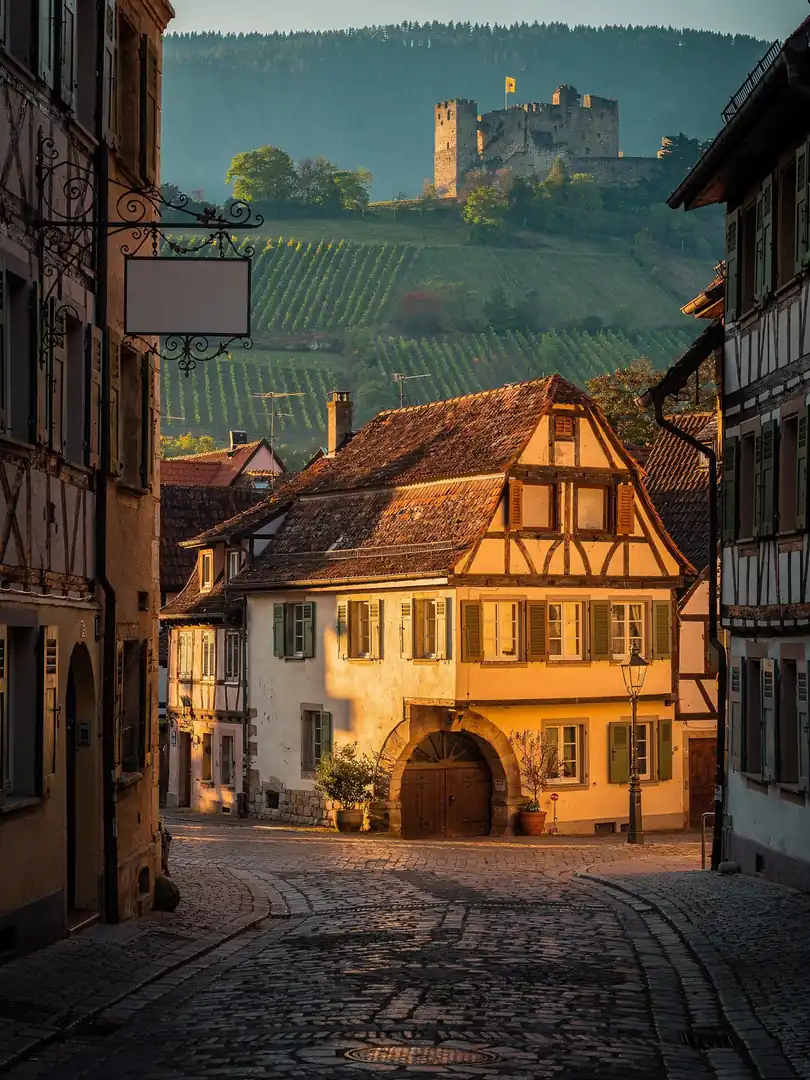
Staufen and Schladerer
Region & History
Searching for Schladerer leads you to Staufen in the Breisgau, at the edge of the Markgräflerland, where the vineyard slopes give way to the Münstertal and, with it, the southern Black Forest. According to legend, this is where Doctor Faust met his end, which is why the town calls itself Fauststadt. The distilling history that this journey follows, however, is more down-to-earth and far better documented than the legend.
According to the house, it begins in 1844. That year, Sixtus Balthasar Schladerer took over the "Kreuz" inn in Staufen and began distilling kirsch there. The inn grew into an operation combining farming, winegrowing, and distilling under one roof. In 1876, his son Hermann took over the inn, which was regarded as one of the most popular houses in Baden.
From 1919, Alfred Schladerer ran the business and expanded the house distillery. Trained as an innkeeper, he made sure the name became known well beyond the region, not least through the square bottle the house is still known for today. Since 2010, Philipp Schladerer has led the distillery in its sixth generation. Officially, it's called Alfred Schladerer Alte Schwarzwälder Hausbrennerei.
The range has broadened since 1844. Alongside the kirsch that started it all, the lineup today includes the Markgräfler Chriesiwässerli from the region's orchard meadows, a red Williams pear, a wild sloe, and the Zibärtle, a wild plum we'll return to shortly.
Some bottles carry the word "Schwarzwälder" before the fruit name. That's more than just a place name: Schwarzwälder Williamsbirne, Mirabellenwasser, Kirschwasser, Zwetschgenwasser, and Himbeergeist have been protected as EU geographical indications since 1989. Legally, the Himbeergeist is classed as a spirit rather than a brandy, a distinction the sections on mash and style will explain in more detail.