Glass Instead of Wood
Maturation & Storage
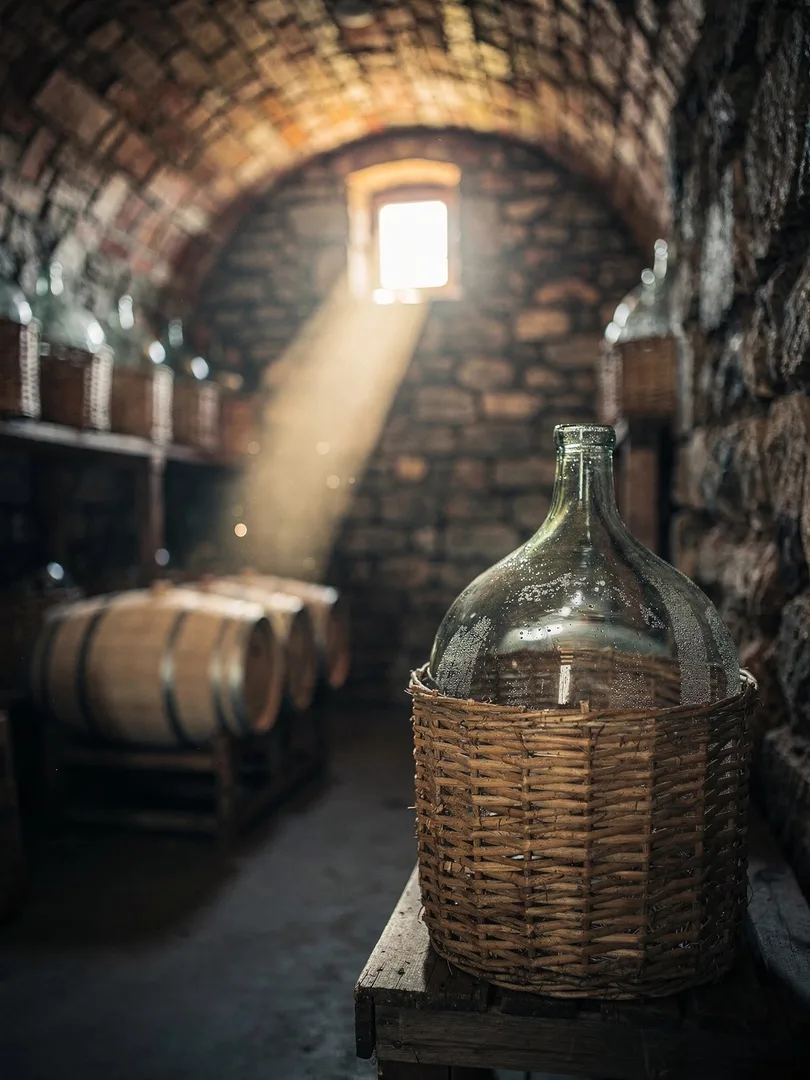
A Williams, once distilled, is meant to taste of pear, not wood, so it rests in glass demijohns or stainless steel, and once in earthenware. These vessels impart nothing and leave the brandy colorless. This holds true for Schwarzwälder Williamsbirne just as it does for Schwarzwälder Mirabellenwasser. To store a brandy well, keep the bottle upright, cool, and dark.
During this time, the brandy is allowed to rest and round out. The sharpness of the fresh distillate fades, the fruit notes settle into place, and the brandy becomes smoother. There's no legal minimum aging period for this; the EU doesn't prescribe age classes.
Still, distillers keep their cellars dark. Under light, the hydrocyanic acid from stone fruit pits can give rise to ethyl carbamate in the finished brandy, a substance considered a possible carcinogen. Germany's Federal Institute for Risk Assessment sets a guideline value of 0.4 milligrams per liter, and the advice is clear: don't store stone-fruit brandies in bright light.
Wood does play a role, however. According to the house, the Zibärtle matures in ash-wood casks, and after at least a year of wood contact, a fruit brandy may be color-adjusted with caramel coloring. Otherwise, the rule holds: coloring is forbidden, and whatever is crystal-clear in the glass stays that way.
If a label reads "alt" or "Reserve," that's a claim made by the producer, not an EU legal age category. Any age statement always refers to the youngest component in the brandy. Anyone wanting to know what's really inside should look at the origin and the vessel, not just the word on the label.