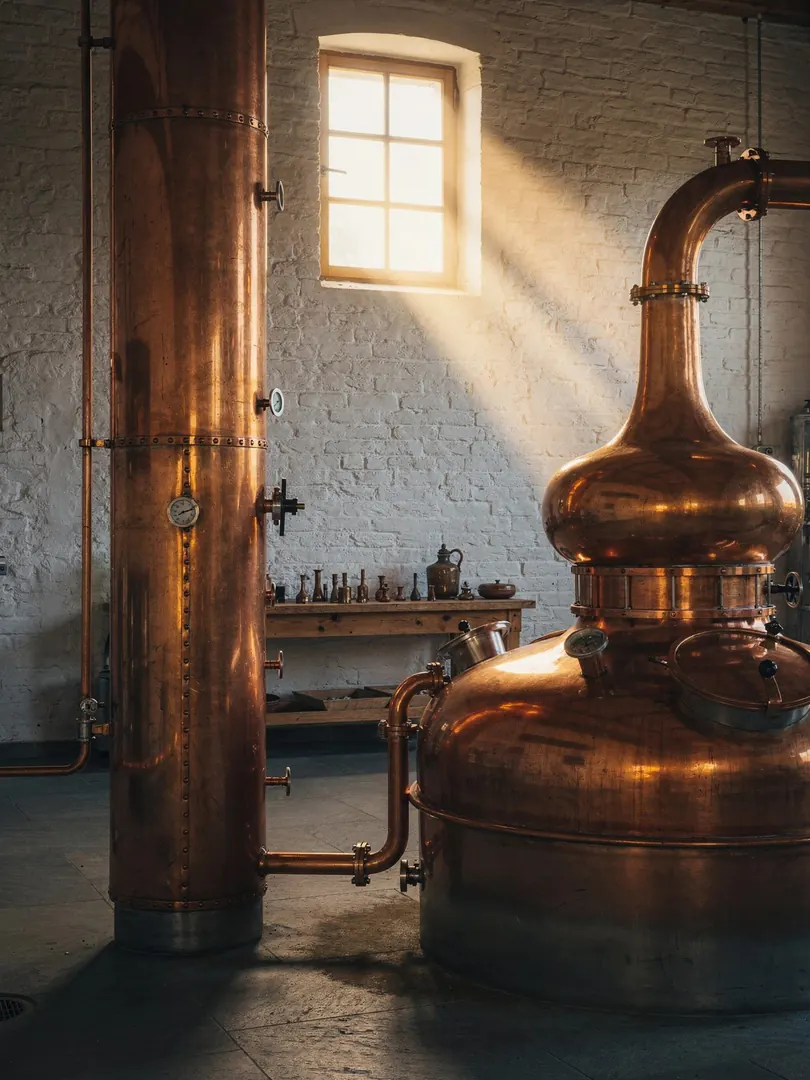
Pot and Column
Distilling
In the copper still, the aromas begin their transformation. As the mash or maceration is heated, alcohol and aromatic compounds evaporate before water does; the vapor rises and is condensed back to liquid in the cooler. The resulting distillate has many times the alcohol content of the mash.
German fruit distilleries often fit a rectifying column atop the pot, which extracts more alcohol from the vapor in a single pass. The classic method is double distillation: first a stripping run, then a spirit run. The same legal rule applies to both fruit brandy and fruit spirit: the distillate must stay below 86% ABV so the fruit's aroma survives and it doesn't become neutral alcohol.
Not everything that runs off ends up in the bottle. The heads, with their light, solvent-like notes, are cut away, as are the tails, with their heavy, fusel-like character. The heart in between, the part that becomes drinkable, is what's kept. For the Zibärtle, according to the house, only this heart cut is matured in the cask. This cut also lowers the methanol content, though only partially.
With Schwarzwälder Himbeergeist, it's the maceration that's distilled, not the fruit itself. The result is a very clear, high-proof distillate that's only later brought down to drinking strength with water. With the Williams, too, there's no blending at the end, just a brandy made from a single variety.
None of this is meant to be tried at home. In Germany, no one may distill alcohol without permission from the main customs office, not even for personal use, and methanol and hydrocyanic acid are exactly why this craft belongs in experienced hands.