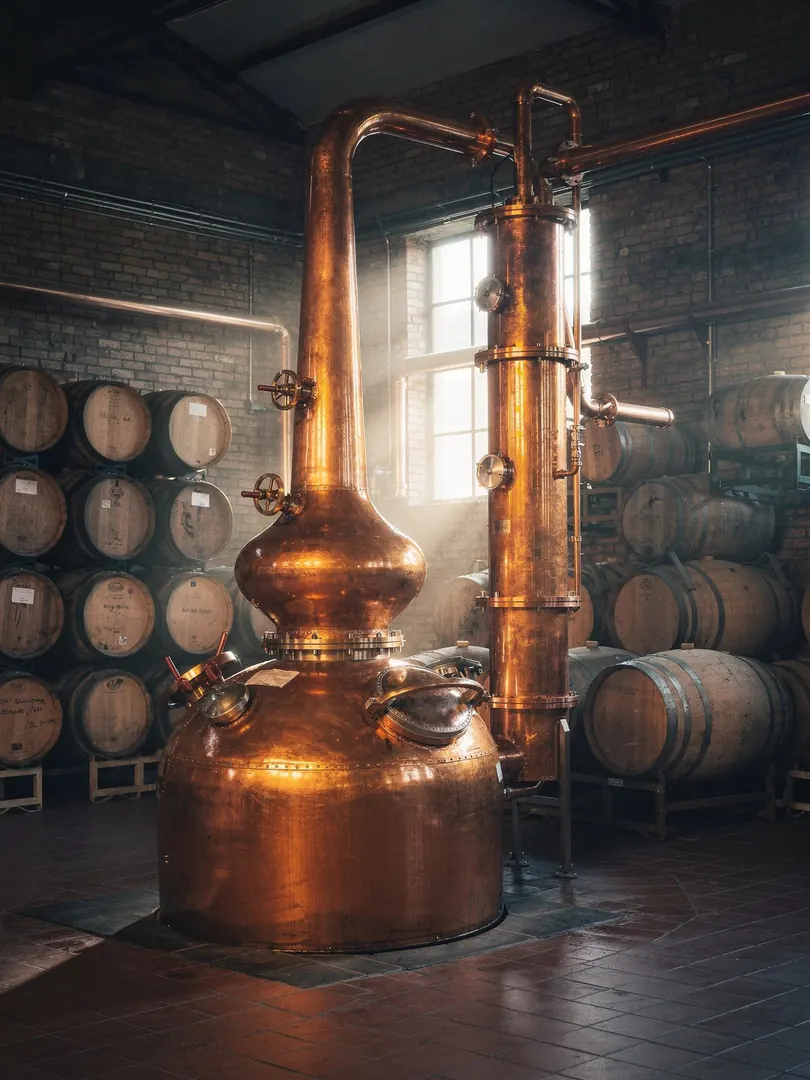
Still and Column
Distillation
How is Weinbrand distilled? In copper pot stills or in columns, and the method shapes the style. During distillation, the wine is heated; alcohol and aromatic compounds vaporize before water does, the vapor is cooled, and it drips back down as distillate.
For Cognac, the rules are tight. It may only be distilled twice in a Charentais pot still, made of copper and heated over an open flame, with the distillate reaching no more than 72.4 percent ABV. A column still is not permitted there.
EU law prescribes neither pot still nor column still for Weinbrand. What matters is that the wine is distilled below 86 percent ABV, so that the wine's aroma is preserved in the spirit. Modern large-scale distilleries use columns, into which the wine flows continuously. This freedom is what distinguishes the Weinbrand of Rüdesheim am Rhein, where Hugo Asbach began in 1892, from the Cognac of the Charentes.
With every pass, the distiller divides the run into three parts. The heads, containing volatile compounds like acetaldehyde and ethyl acetate, smell of solvent and are cut away. The heart is the centerpiece, which later goes into the cask. The tails, containing heavy, fusel-like compounds, are also cut away and often redistilled.
It's a myth that the heads cut removes all the methanol: separating it only reduces the level partially. That's why limits apply to the finished product. And anyone wanting to produce alcohol in Germany needs a permit from the main customs office; a home still remains illegal.