White Wine as the Raw Material
Fruit & Raw Material
What grapes is Weinbrand made from? From white grapes, and specifically from wines that taste rather unremarkable on their own: light in alcohol, sharp in acidity, without much aroma. That's exactly what the distiller needs, because distillation only preserves what's already in the wine.
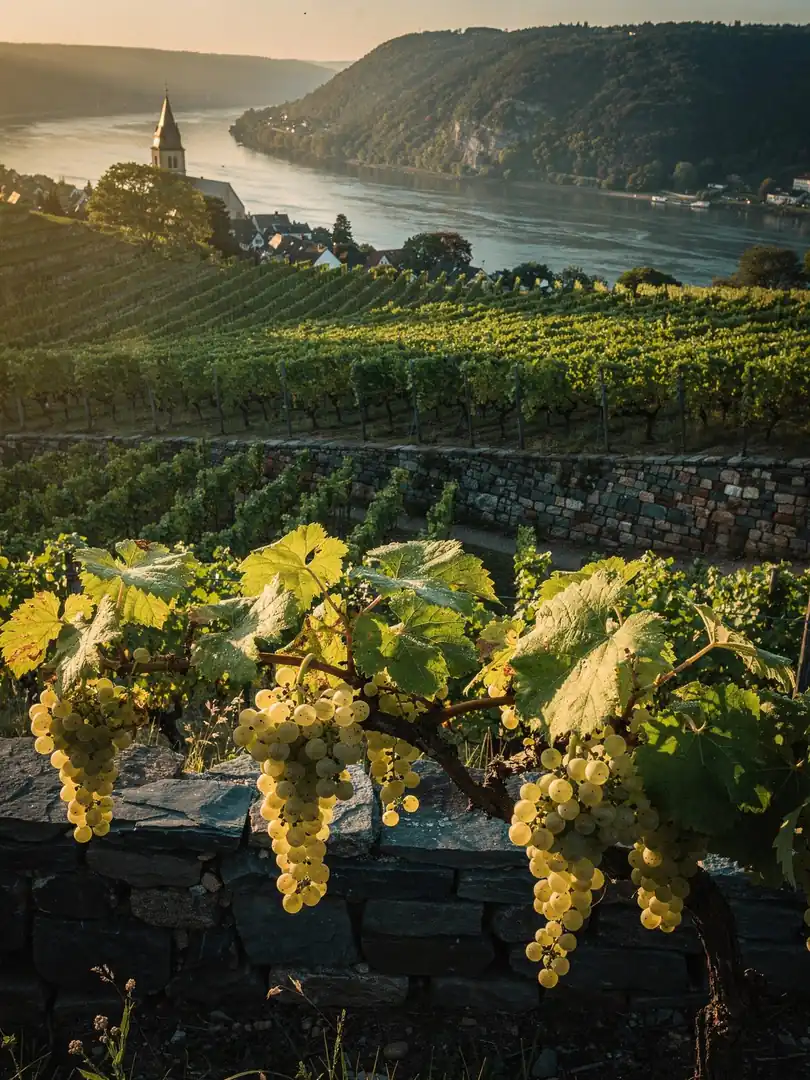
The Rheingau stands for Riesling, and the Rüdesheimer Berg is one of its well-known vineyard sites. Yet Riesling doesn't end up in the Weinbrand still: a Riesling should taste like Riesling, while a Weinbrand should taste of wood, vanilla, and dried fruit. According to trade press reports, Asbach uses white grapes that come mainly from France and Italy.
For comparison, Cognac's wine is about 98 percent Ugni blanc, a high-acid, late-ripening grape. Colombard, Folle blanche, Montils, and Sémillon are also permitted, with Folignan capped at a maximum of ten percent. EU law, by contrast, prescribes neither a growing region nor a grape variety for Weinbrand.
What may go into the brandy is strictly regulated. It consists of eau-de-vie, meaning pure wine distillate, to which up to half the alcohol may come from a more highly distilled wine spirit. Foreign alcohol is forbidden, as is added flavoring.
Those looking for a brandy made from pressing residues will find a different category: Grappa and Marc are pomace brandies made from grape skins. Weinbrand, by contrast, is made from finished wine, which gives it a milder, finer character. Rüdesheim lends it its craft and its name, while the grapes mostly come from farther afield.