Meadows and Tax Law
Region & History
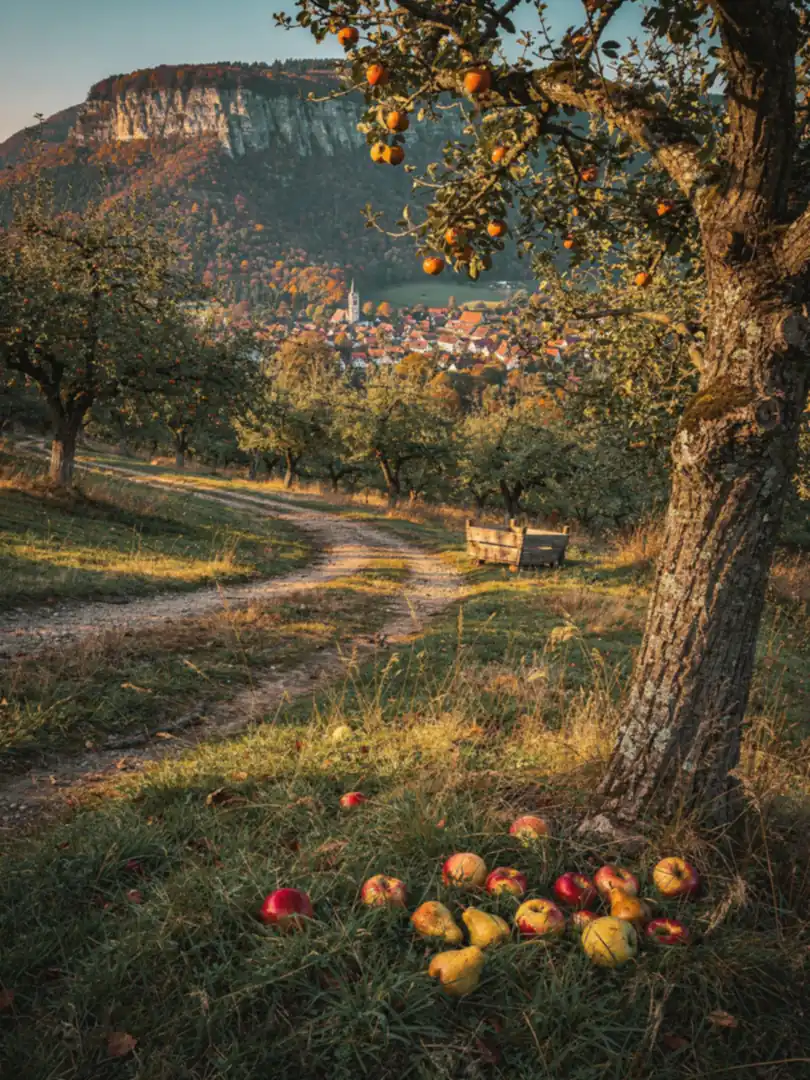
Anyone driving along the Alb escarpment in autumn will see, below the ridge line, a belt of standard-trunk fruit trees rising and falling with the terrain. The administration of the Swabian Alb Biosphere Reserve calls it the largest contiguous belt of orchard meadows in Europe. Mostly apples, pears, cherries, plums, and walnuts grow here.
Distilling here was never done on an industrial scale, but rather from whatever the meadows provided. The orchard meadows reached their greatest extent around the turn of the 19th to the 20th century. Even after the Second World War, they still supplied households with fruit, cider, and jam. Since the late 1950s, many standard-tree meadows have been cleared and replaced with low-growing plantations that produce marketable table fruit.
What this has to do with fruit brandy becomes clear through tax law. The spirits monopoly, which bound fruit distilleries until 31 December 2017, has been abolished; since 1 January 2018, the Alcohol Tax Act has applied. Alcohol from allowance distilleries and from raw material owners is taxed at a reduced rate within the permitted quantity, well below the standard rate applied to everyone else. Lawmakers justify this reduction as a way to preserve the orchard meadows. So anyone who turns fruit into brandy is, indirectly, keeping alive trees that hardly anyone else would still harvest.
As an allowance distillery, an operation may produce no more than 300 litres of pure alcohol per year. This requires an agricultural holding of at least 3 hectares, or 1.5 hectares in the case of intensive fruit growing or viticulture. Since 2018, the permit belongs to the individual rather than the farm: anyone taking over an operation must reapply within three months.
There is no dedicated EU designation of origin for brandies from the Alb. The meadows themselves carry the name. In 2009, UNESCO recognised the central Alb as a biosphere reserve, and this status was renewed for ten years in 2021; the Biosphere Centre is based in Münsingen. Many orchard-meadow projects come together there too, from variety conservation to marketing.