Standard Trees, Cider, Brandy
Fruit & Raw Material
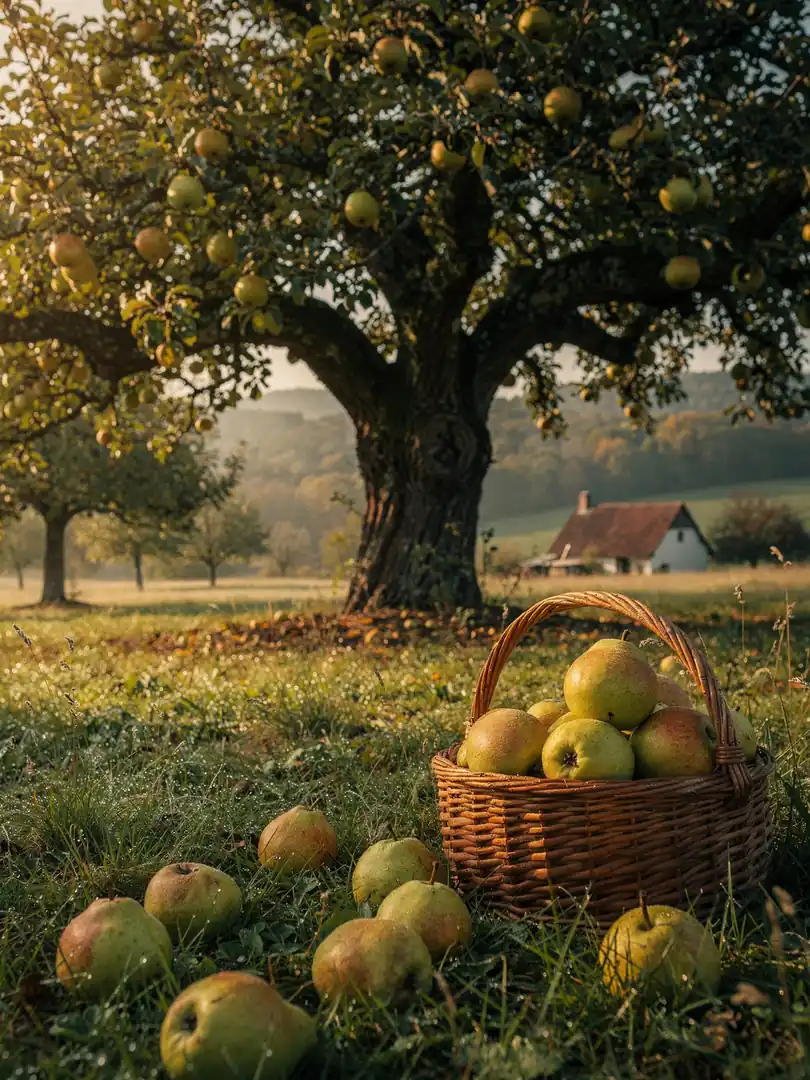
A perry pear tree on the Alb is no garden tree. It grows into a mighty, standard-trunk crown, can live for several hundred years, and in good years bears so much fruit that by October the ground beneath it is littered with pears. Perry pears are small, hard, and rich in tannins. Hardly anyone wants to eat them raw, but in cider and in brandy these very qualities are exactly what's called for.
In Württemberg, the Champagner Bratbirne, the Palmischbirne, and the Schweizer Wasserbirne are considered classic perry pear varieties. The Wasserbirne is described as a high-yielding pear for cider and drying, with fruit ripening from early to mid-October and keeping for several weeks. None of these varieties may lend its name to a brandy: 'Williams' is legally reserved solely for the Williams Christ pear.
Alongside the pear trees stand apple trees better suited to juice and mash than to the fruit bowl. Distilling apples are varieties chosen for yield, vigour, and aroma rather than looks. Cherries, plums, and walnuts round out the mix. This blend of ages and varieties is deliberate, since it's the only way the harvest spreads across the whole autumn. Orchard meadows are generally managed without synthetic plant protection products.
Harvesting happens once the fruit falls or can easily be shaken down. At that point, the local cider presses run at full capacity, and anyone wanting a brandy brings their fruit to the distillery. Rotten or mouldy fruit has no place in the crate, since every flaw in the fruit later turns up in the glass.
Why apples and pears in particular? Because they thrive on the meadows along the Alb escarpment with little effort, and because regulation requires Obstler to consist of at least 85 percent of these two fruits. It all fits together: what the landscape provides is exactly what the law demands for this particular brandy.