Glass Instead of Oak
Maturation & Storage
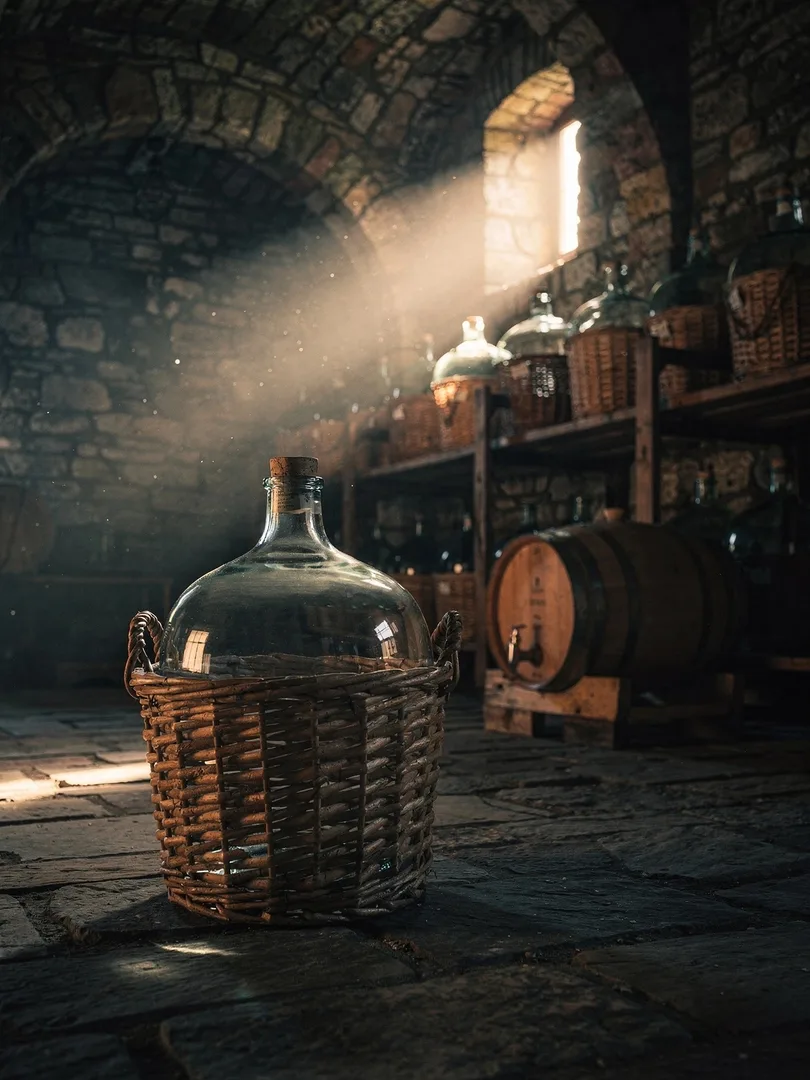
In the cellar of a fruit farm, you'll often find glass demijohns in wicker baskets, where the fresh distillate rests. Freshly distilled fruit brandy still smells sharp and unruly; in a neutral vessel it settles down, and the fruit aroma comes to the fore. That's why Obstler and pear brandy are usually crystal clear. Glass, stainless steel, and formerly stoneware don't change the brandy — they neither give anything up nor take anything in.
Wood is permitted for fruit brandies, just not the norm. Oak, ash, acacia, and other woods are used. Letting a brandy rest longer in wood brings colour and a spicy note that sits differently against pear aroma than a plain cask would. After at least one year of contact with wood, the brandy may be evened out in colour using caramel colouring; colouring without meeting this condition is prohibited.
EU regulations set no fixed minimum maturation period for fruit brandy, not even for an Obstler from the Alb escarpment. That's why one should be cautious with words like 'old' or 'reserve' on a label: these are producer claims, not legal terms. A rule does apply here too, though. When an age statement is given, only the youngest component of the brandy counts, and the ageing must have taken place under tax supervision. A blend of old and young vintages therefore cannot claim the age of its oldest component.
In the end, the brandy is cut down to drinking strength with demineralised water, since it comes off the still considerably stronger. After that it needs time to rest, usually a few weeks to months, until the water and alcohol have married. It shouldn't sit somewhere bright or warm during this time: light and heat damage the aroma of a fruit brandy. A raw material owner collecting their 50 litres of alcohol after custom distilling usually stores the brandy themselves, in the cellar or pantry, and bottles it into smaller bottles as needed.