Custom Distilling, 50 Litres
Distilling
In Germany, distilling without a permit is a criminal offence. That applies to the garage too, and even to personal use. Distilling is only legal in a bonded distillery or an allowance distillery, and for private individuals with their own fruit there is exactly one legal route: becoming a raw material owner. This requires no equipment of one's own; instead, the fruit is distilled at an allowance distillery. This custom distilling is the norm on the Alb.
The limits are tight. A raw material owner may produce at most 50 litres of pure alcohol per year, one person per household. It must be their own fruit, grown within the tax territory. An allowance distiller and their household are excluded from acting as raw material owners. The figure of 2 litres sometimes mentioned isn't a distilling allowance at all, but the threshold above which purchasing stills must be reported.
At the distillery, the fruit isn't weighed so much as calculated. Under the allowance system, the alcohol isn't measured directly but calculated from the quantity of raw material using an official yield rate. Every distilling run must be registered in advance, so the main customs office knows what is being distilled and when.
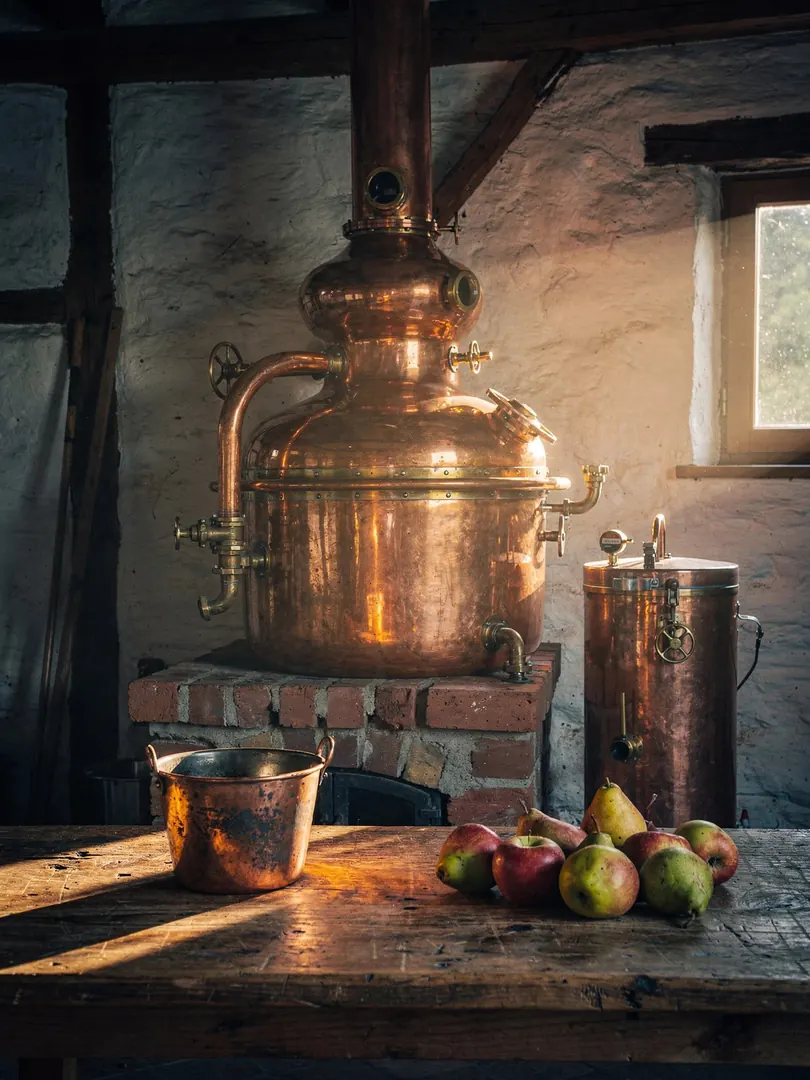
Distilling takes place in a copper still, which in many fruit distilleries carries an attached column. In the still, the mash is heated; alcohol and aromatic compounds rise before the water does, are cooled, and flow off as distillate. Those who double-distil first separate out the low wines, then distil these again into the final spirit.
The distiller divides the distillate into three parts. The heads smell of solvent and are cut away. The hearts, the heart of the run, are the drinkable portion. The tails are heavy and fusel-laden and are either cut away or redistilled. Methanol can only be partly reduced by cutting the heads, since it's distributed throughout the entire run.