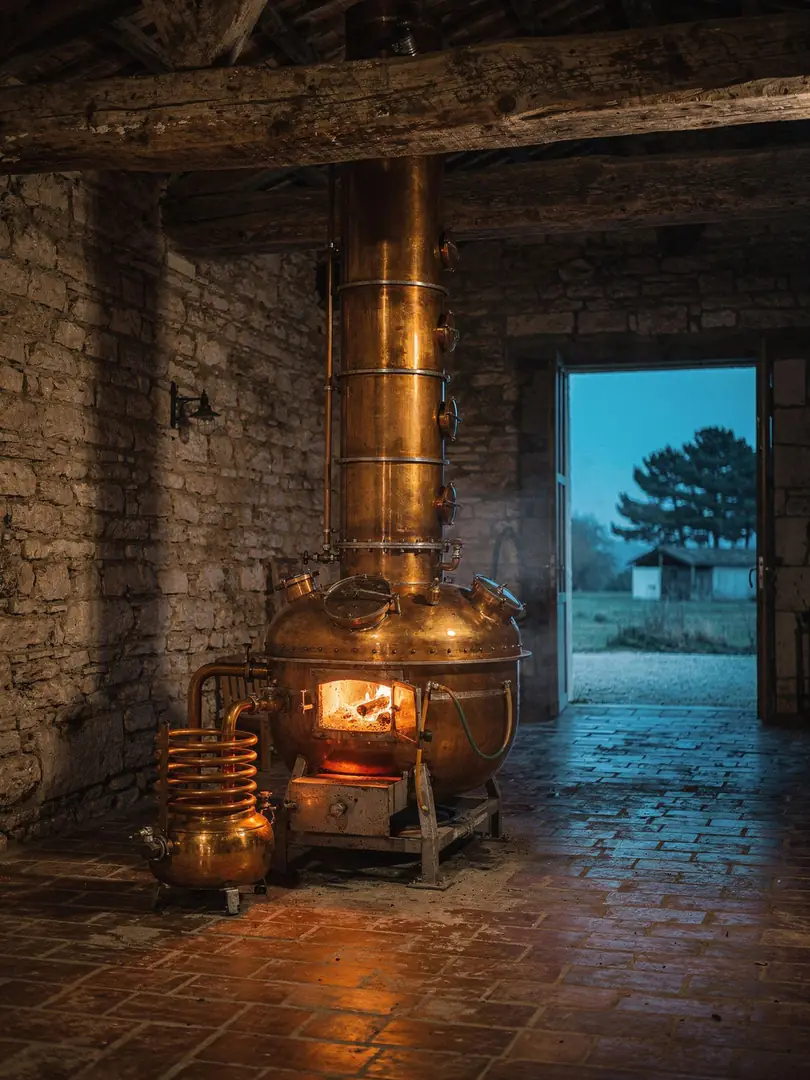
Column Still with Open Flame
Distillation
How is Armagnac distilled? Usually just once, in a continuous process. The main method uses the alambic armagnacais, a column still with plates through which the wine flows continuously. In 2012, 95 percent of the appellation's distilling wine was processed this way.
Here's how the column works: wine trickles down over the plates while a kettle with an open flame supplies heat. At each plate, vapor and liquid meet, and the alcohol concentration builds stage by stage. The rising vapors carry the aroma compounds upward and condense back into liquid in a cooling coil. Cold incoming wine flows through the same coil, warming up in the process.
Because the spirit emerges at a comparatively low strength, more congeners are preserved. This is considered the reason young Armagnac tastes bolder and more rustic than young Cognac. Whether a distiller runs the fire hotter or cooler shapes the house style.
The spirit leaves the still at 52 to 72.4 percent ABV. A still may produce no more than 40 hectoliters of pure alcohol per day, and every producer who distills must operate at least one still of this type. Fresh from the column, Armagnac is colorless.
Double distillation in a pot still is also permitted, yielding 65 to 72.4 percent ABV. Unlike Cognac, which is always double-distilled in copper pot stills, the pot still remains the exception in Armagnac production.
Many winegrowers don't own their own equipment. For them, the alambics ambulants, mobile distilleries, travel from farm to farm distilling the wine on-site. The distiller controls the fire and feed by taste and smell to get the strength and aroma just right. For anyone in Germany thinking of trying this: distilling without a permit is illegal there.