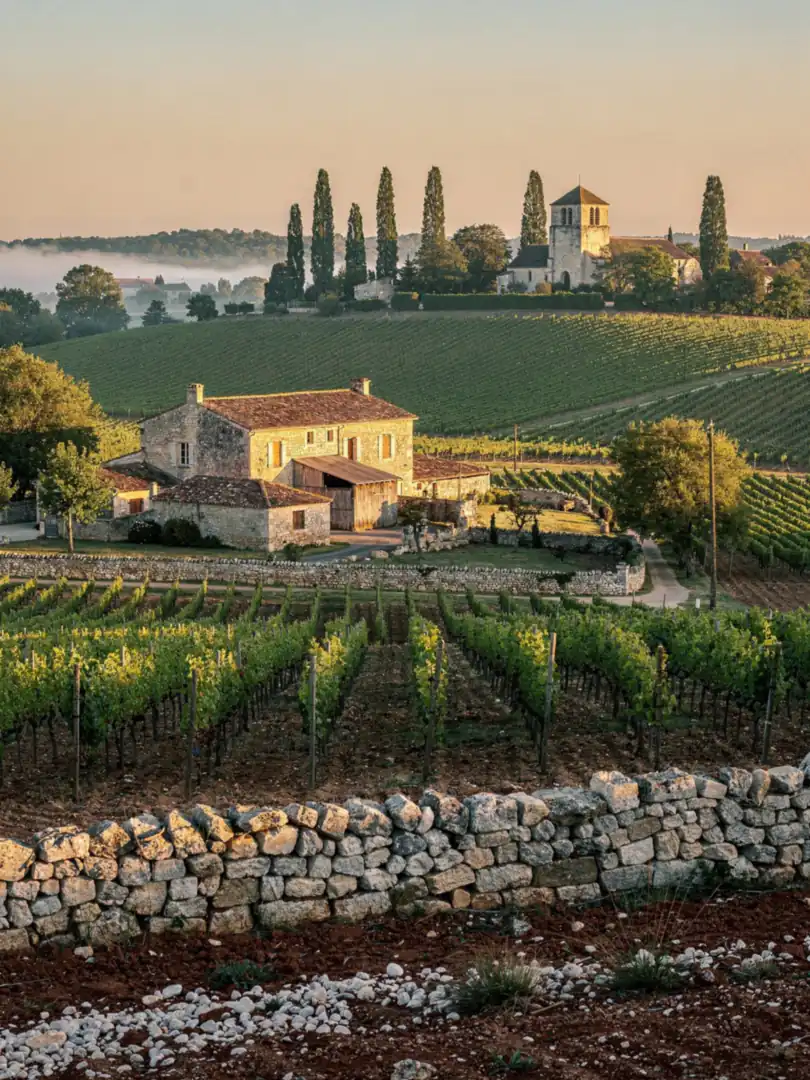
Four Crus
Region & History
Alongside Grande Champagne and Petite Champagne, Cognac has four further crus rarely mentioned on labels: the Borderies, the Fins Bois, the Bons Bois and the Bois ordinaires, officially also called Bois à terroirs. Together they account for the larger share of the vineyard area, and their distillates frequently find their way into blends.
The Borderies are the smallest of the four inner crus. On roughly 4,000 hectares of vines northwest of the town of Cognac lies a high plateau of clay and limestone studded with flint, known in France as silex. The soil is heavier and moister than the chalky ground of the Champagnes, and the climate is considered somewhat cooler. The result is brandies that bottlers like to describe as soft and floral.
With more than 30,000 hectares, the Fins Bois form the largest cru, wrapping like a broad belt around the other inner crus. In the north, the "groies" dominate — shallow, reddish clay-limestone soils with hard Jurassic stones, similar to those of the Champagnes but darker. Further south, the subsoil dates from the Cretaceous and Tertiary periods.
Bons Bois and Bois ordinaires form the outer edge of the region. There, sandy soils mix in, long ago eroded from the Massif Central. Along the Atlantic coast and on the islands of Île de Ré and Île d'Oléron, a maritime climate adds its own damp character. Around 12,000 hectares belong to the Bons Bois, while the Bois ordinaires remain small in area.
Cognac has been registered as a protected geographical indication since June 12, 1989, with the individual crus delimited by decree in 1938. Before that, phylloxera, which reached the Charente around 1875, had shrunk the vineyard area from 280,000 to roughly 40,600 hectares by 1893.