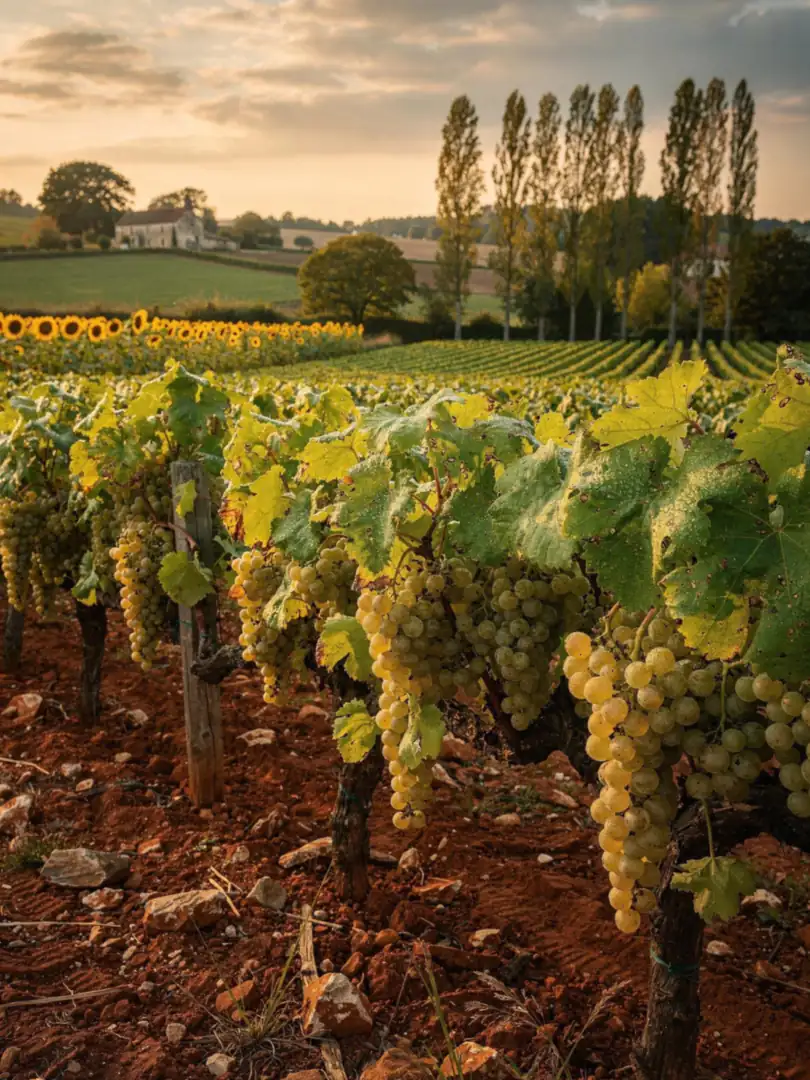
Ugni blanc
Fruit & Raw Material
Ugni blanc, known in Italy as Trebbiano, covers more than 98 percent of Cognac's vineyard area. The grape ripens late, yields generously, and produces a high-acid wine low in alcohol. Such a wine makes for a fresh distillate, since both acidity and aroma concentrate during distillation. Armagnac permits ten grape varieties, whereas a single one dominates the Cognac region.
The appellation rules also allow Colombard, Folle blanche, Montils and Sémillon, plus Folignan up to a tenth of the blend. Yet anyone driving through the vineyards sees almost nothing but Ugni blanc. The rows stretch between grain fields, sunflowers and small patches of woodland, and an average estate in the Cognac region farms around 20 hectares.
The soil shapes each cru differently. In the Borderies, the vines grow on heavy clay with flint; in the Fins Bois, on red, stony groies; in the Bons Bois, partly on sand; and along the coast, on Ré and Oléron, mostly on sandy ground. Whether this later shows in the glass is something bottlers who keep the crus separate like to test. Single-cru bottlings such as those from the Borderies live precisely on this idea, and they are the reason small crus ever earn a name on the label at all.
Harvest falls in early autumn, usually in October. Grapes are picked for acidity and sugar, and the wine is meant to stay lean. On Ré and Oléron, salty sea air drifts over the rows — the islands are reachable by bridge — and small vine parcels lie scattered among dunes, salt marshes and oyster beds.
Today the region counts 87,648 hectares of vines, more than double the low point after phylloxera. Since almost everything is Ugni blanc, the differences between the crus arise less from variety than from soil, climate and maturation.