Oak and Time
Maturation & Storage
At least two years in oak casks are required by the appellation rules before a distillate may be sold as Cognac. How long Cognac from the Borderies and the Bois crus actually matures is then decided in the cellar: many bottlings rest far longer in wood, up to decades. How quickly a brandy develops is judged by the cellar master through smell and taste, not by the calendar.
The pace also depends on the cru. Brandies from the Borderies and the Fins Bois are considered rounder and more approachable earlier than those from the Champagnes, and Cognac from the coastal Bois ordinaires is often described as mature after roughly 15 years. For bottlers, this means stocks need not lie in cellar as long before a brandy is ready for sale.
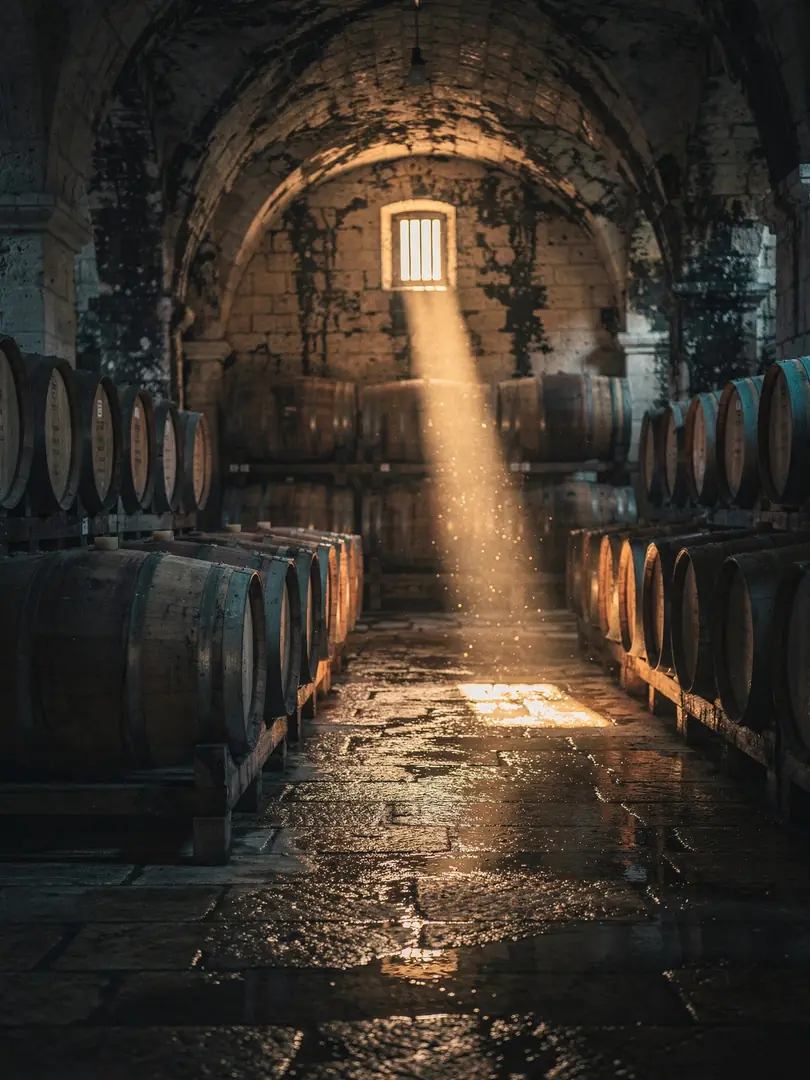
The wood breathes. Every year around 41 million bottles' worth of Cognac evaporates through the cask staves — the so-called angels' share — while about 2.2 billion bottles' worth rests in the region's casks at any one time. In the process, the oak releases tannins and vanilla notes, and the brandy gradually loses its sharp edges.
Fresh from the still, the brandy holds up to 72.4 percent alcohol; it is sold at a minimum of 40 percent. In between lies the dilution with water, usually carried out in stages so the brandy does not fall out of balance.
Small corrections are permitted: caramel coloring, sugar and oak infusion may be used within tight limits to even out color and roundness. Which age statement appears on the label depends on the youngest brandy in the blend, regardless of cru. Once a brandy has grown very old, some houses transfer it from cask into large glass demijohns so it absorbs no further wood character. There it rests without aging further.