Twice Through Copper
Distillation
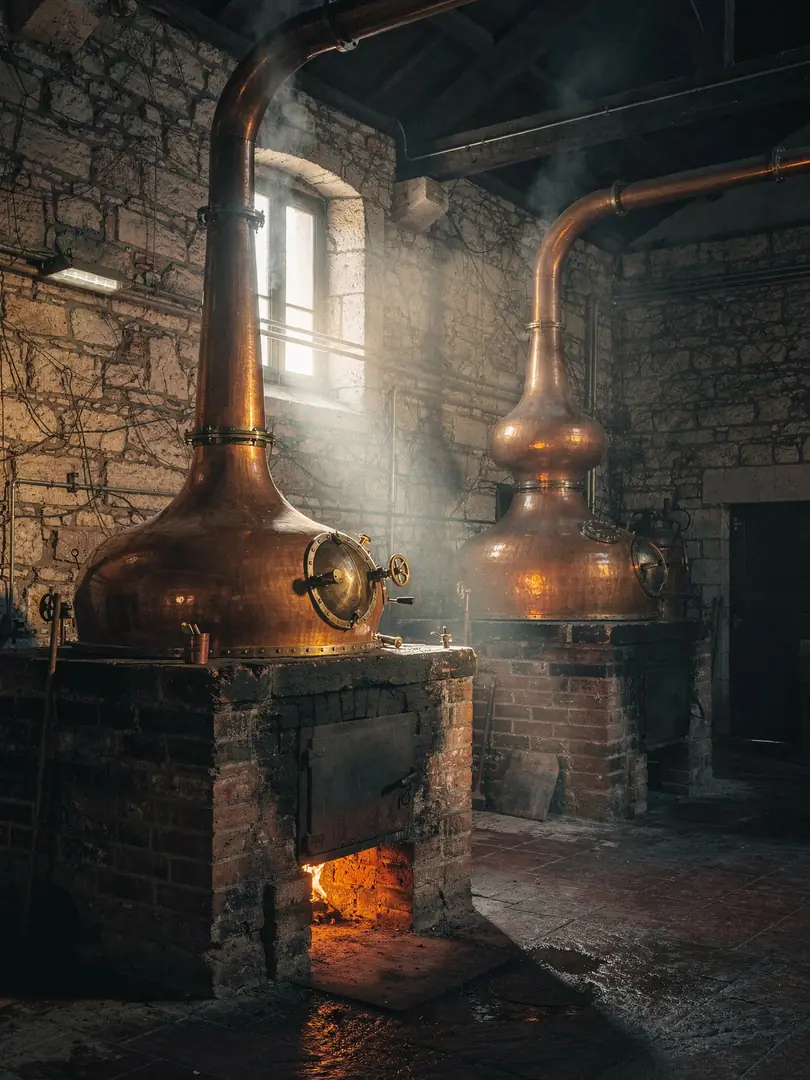
Cognac is distilled twice, never three times and never in a column still. The law requires the Charentais pot still, a copper still heated over an open flame. For the second pass it may hold no more than 30 hectolitres and be charged with no more than 25.
According to the trade, the first pass takes around twelve hours and yields the brouillis, a distillate of roughly 28 to 32 percent alcohol. This is then heated a second time, the so-called bonne chauffe. Distillation happens twice because the first pass separates alcohol and aroma from the wine, while the second purifies and further concentrates them.
As with any distillation, the distiller separates the run into three parts. The heads, here called 'les têtes,' contain highly volatile compounds and are cut away. The heart, 'le cœur,' is the part that will later age in cask. The tails, 'les queues,' contain heavy compounds and too little alcohol. Both heads and tails may be added back into the next distillation run.
After the second pass, the spirit sits at no more than 72.4 percent alcohol, as required by law. It's colourless and known as 'eau-de-vie,' water of life, and its aroma is still raw. It's a long way from what will eventually be in the glass.
La Brennende, the end of the distilling season, is a fixed point: the last batch must be distilled by 31 March following the harvest. In winter, the stills often run day and night as a result.
A third pass is forbidden, except for Esprit de Cognac, which at 80 to 85 percent alcohol is intended solely for sparkling wine production. Almost 3,000 stills are in operation across the region, including those run by the 131 professional distillers.