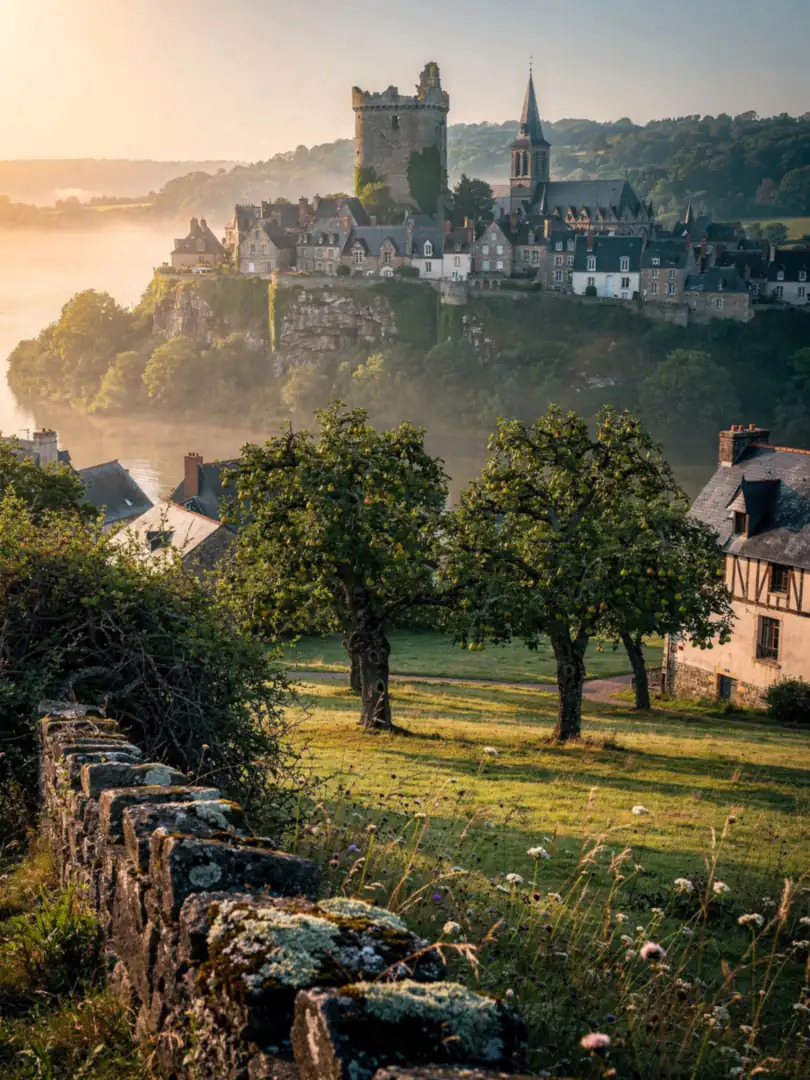
Pears in the Bocage
Region & History
What sets Calvados Domfrontais apart from other Calvados can be summed up in one word: pear. The spirit comes from the south of Normandy, from the hilly landscape around the town of Domfront in the Orne département, and must be made from at least 30 percent perry pears. With standard Calvados, apples take center stage, and in the Pays d'Auge, pears are permitted only up to 30 percent.
Domfront itself sits on a rocky outcrop above the Varenne valley, with the remains of a medieval castle at its back. All around lies the Bocage, a landscape of hedgerows, small pastures, and orchards. Among them stand tall standard pear trees — according to regional figures, more than a hundred thousand of them, some over three hundred years old.
Two drinks come from this pear country. One is Poiré Domfront, a lightly sparkling perry with its own protected designation of origin. The other is the spirit: distilled from cidre and poiré, that is, from fermented apple juice and fermented pear juice. Distillation here takes place not in a pot still, but in a column still.
The EU register lists three Calvados designations side by side: standard Calvados, Calvados Pays d'Auge, and Calvados Domfrontais. In addition to the pear requirement, the Domfrontais demands column distillation and at least three years in oak, while standard Calvados requires only two. The register also lists Eau-de-vie de cidre de Bretagne and Eau-de-vie de cidre du Maine as separate protected names — apple brandies from Normandy's neighboring regions.
Today, small family estates shape the picture. The Lemorton estate is, by its own account, now run by the third generation and is known for vintage-dated spirits. Christian Drouin, otherwise a name associated with the Pays d'Auge, operates the Lauriston distillery in the Domfrontais, according to the house.